
Genesis 6:9 to 9:29
The End of Nature

Image Caption: Babylonian Map of the World. Source: The Imago Mundi: Babylonian Directions to Noah’s Ark (Armstrong Institute) [https://armstronginstitute.org/1127-the-imago-mundi-babylonian-directions-to-noahs-ark]
Irving Finkel at the British Museum deciphered a text on a 2900-year-old Babylonian Map of the World that depicts the location of the ark. The tablet's cuneiform text details an ancient flood story in which a survivor builds a giant ark. The Babylonians refer to the shipbuilder as Utnapishtim. Recent translations of the tablet's back describe a traveler's journey toward remote mountain regions, and that the ark came to rest on a mountain they called "Urartu". Scholars equate this with biblical "Ararat," where Noah's Ark landed. The tablet includes the parsiktu, a measurement applied elsewhere only to the ark, which ties this map’s text to other Babylonian flood narratives.
Mesopotamian Flood Accounts
The Mesopotamian flood stories are among the earliest surviving works of literature, forming a mythos that influenced later flood accounts, such as the biblical story of Noah's ark.
Ancient Mesopotamian flood accounts are epic narratives. They share a common framework: the gods decide to eradicate humanity by a massive deluge, but a compassionate deity warns one chosen to build a huge boat to save humanity and repopulate the earth. There are three cuneiform flood accounts.
- The Sumerian Deluge Account (Nippur Tablet) (Sumerian, ca. 2100 BC) is the oldest record of a global flood. This 'Eridu Genesis' tells the story of Ziusudra, a pious and humble king. The high council of gods (led by Enlil) decides to wipe out mankind. The god of wisdom, Enki (Ea), betrays the secret to Ziusudra, instructing him to build a giant boat. After a devastating deluge lasting seven days and seven nights, Ziusudra opens a window to let in the sun god, Utu, and sacrifices animals to the gods in gratitude. He is subsequently granted immortality by Enlil.
- The Atrahasis Epic (Tablet III) (Old Babylonian, ca. 1800 BC) provides an account of why the flood happens: the gods are exhausted by the noise and overpopulation of humans and try to starve or plague them out before resorting to a deluge. The god Enki instructs his favorite, Atrahasis ("Exceedingly Wise"), to build a huge, waterproof ark. After a seven-day flood, Atrahasis offers sacrifice. The scent draws the starving gods, who promise never to trigger such a disaster again, and they establish new birth controls (infertility, infant mortality) to prevent the human population from growing too populous.
- The Gilgamesh Epic (Tablet XI) (Neo-Assyrian, ca. 7th Century BC) was compiled from Sumerian and Babylonian tales. The hero Gilgamesh, during his quest for eternal life, travels to interview an immortal named Utnapishtim (the counterpart to Ziusudra and Atrahasis). Utnapishtim explains how the gods decided to flood the city of Shuruppak. Warned in a dream by Ea, Utnapishtim builds a multi-deck cube-shaped boat and onboards his family, craftspeople, and numerous living creatures. After six days and nights of destruction, the boat rests on Mount Nimush (Nisir). To check for dry land, he releases a dove, a swallow, and a raven. After exiting the ark, he makes a sacrifice, which pleases the gods, leading them to grant Utnapishtim and his wife immortality.
These Mesopotamian myths already held several hallmarks of the later account of Noah's Ark: an exclusive divine warning to a favored man, ark-building specifications, a cataclysmic flood, the ark grounding, the release of birds, and a pleasing post-flood sacrifice that placates divine wrath.
The Mesopotamian Flood Hero
Four names — one hero
- Ziusudra, Sumer, Sumerian Deluge Account, 2150 BC
- Atra-Hasis, Akkad, Atrahasis Epic, 1800 BC
- Uta-Napishti, Babylon, Gilgamesh Epic XI, 1300 BC
- Noah, Israel, Genesis 6–9, 1000 BC
Among the Mesopotamian flood stories, there appears to be a common literary ancestry. The hero’s name may change, depending on source language and culture, but the historical derivation seems common. In each case, the name of the hero seems to be role based, rather than historical.
Sumerian Culture (4100 to 1750 BC)
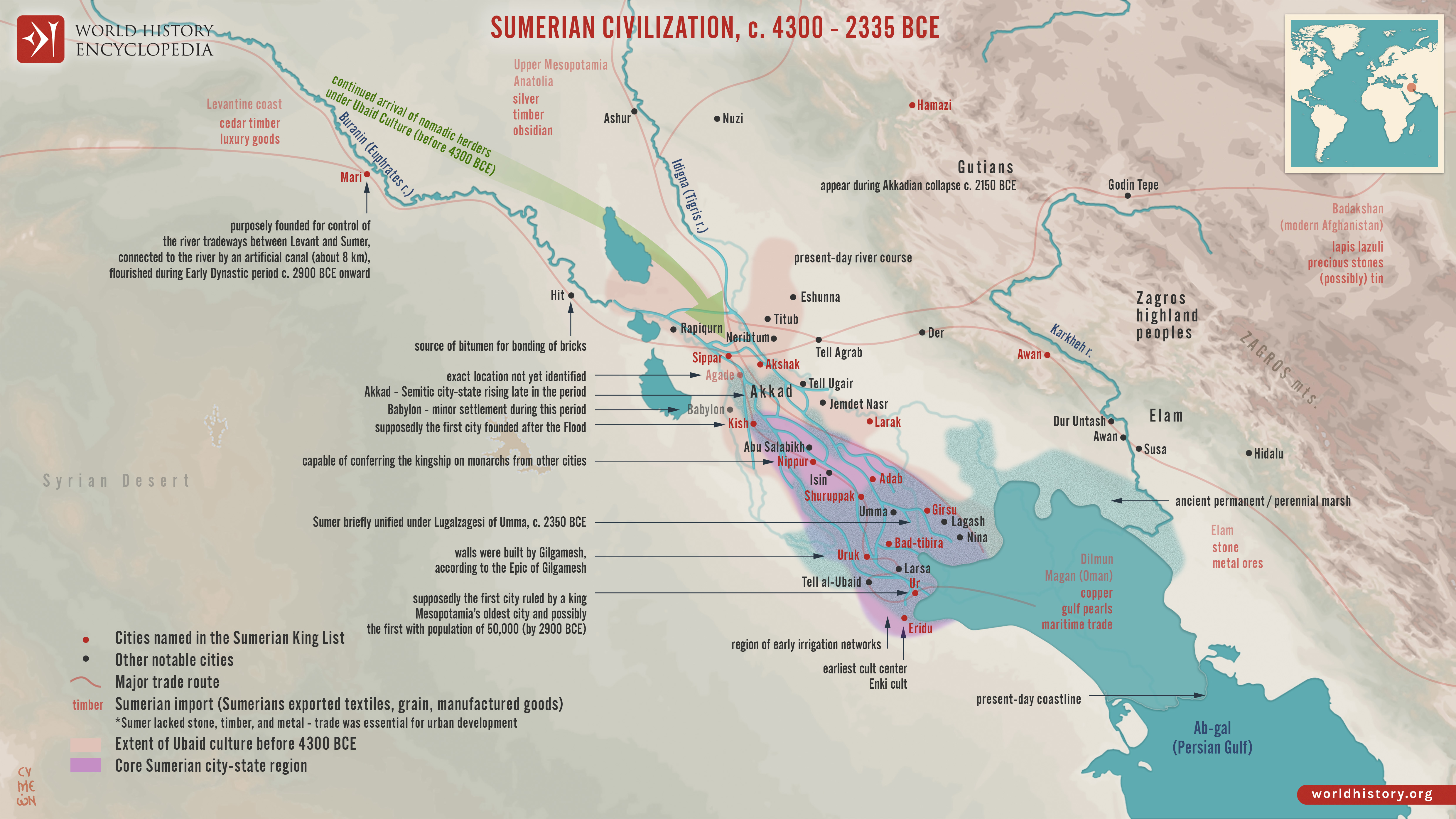 (Enlarge image)
Image Caption: Sumerian city-states arose to prominence as a result of the elaborate trade among river cities in the ancient estuaries of the Tigris and Euphrates Rivers. Source: Netchev, Simeon. Map of the Sumerian Civilization (World History Encyclopedia, February 27, 2026) [https://www.worldhistory.org/image/15299/map-of-the-sumerian-civilization/] and [https://www.worldhistory.org/uploads/images/15299.png?v=1780978161-1773135475]
(Enlarge image)
Image Caption: Sumerian city-states arose to prominence as a result of the elaborate trade among river cities in the ancient estuaries of the Tigris and Euphrates Rivers. Source: Netchev, Simeon. Map of the Sumerian Civilization (World History Encyclopedia, February 27, 2026) [https://www.worldhistory.org/image/15299/map-of-the-sumerian-civilization/] and [https://www.worldhistory.org/uploads/images/15299.png?v=1780978161-1773135475]
Sumerian civilization, the world's earliest known urban society, flourished in southern Mesopotamia (Iraq) from 4100 to 1750 BC. It had four main phases.
- Uruk Period (ca. 4100 to 2900 BC): The birth of the first true cities, such as Uruk, and the invention of writing (cuneiform).
- Early Dynastic Period (ca. 2900 to 2334 BC): The rise of organized city-states (Ur, Lagash, and Kish) and of dynastic kingship.
- Akkadian & Neo-Sumerian Periods (ca. 2334 to 2004 BC): Intermittent periods of Sumerian dominance and temporary conquests by outside forces, including Sargon the Great.
- Decline & Collapse (ca. 2004 to 1750 BC): The fragmentation of Sumerian cities and their collapse of authority gave way to the rise of Amorite and Babylonian empires.
Sumerian River Culture: Uruk Boat Cylinder Seal
 (Enlarge image)
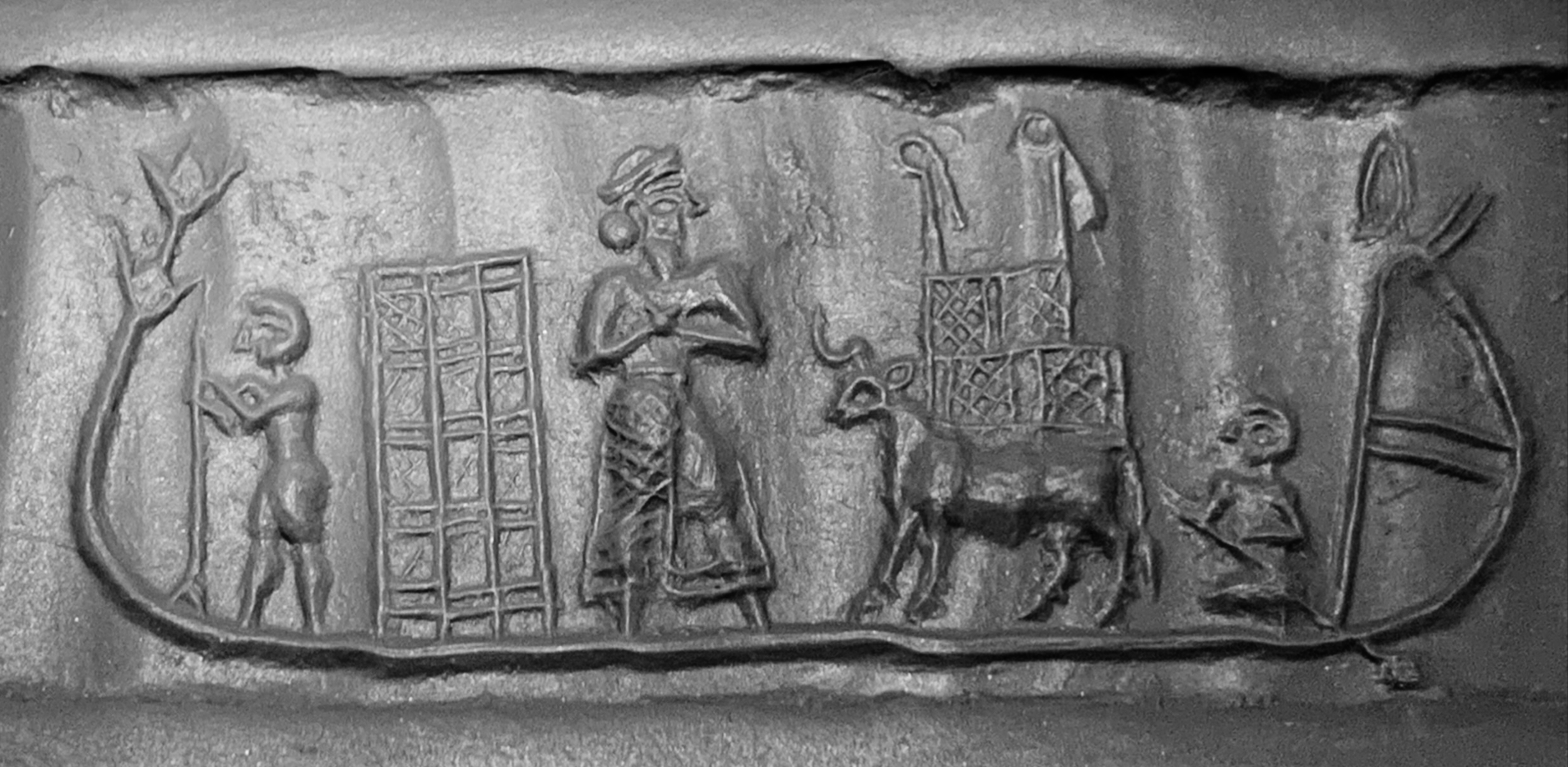
Image Caption: Uruk Boat Cylinder Seal: recovered from Uruk (biblical Erech). The seal depicts a king-priest riding a Late Uruk reed ship with crates, a bull, and boatmen (ca. 3300 to 2900 BC). Staatliche Museen Zu Berlin, Vorderasiatisches Museum, Excavated 1933–34; VA 11040. Source: Uruk Flood Cylinder (Dig Deeper) [http://master1844-dc.blogspot.com/2016/12/archaeology-uruk-flood-cylinder.html] and Source: Uruk period (Wikimedia) [https://en.wikipedia.org/wiki/Uruk_period] and [https://upload.wikimedia.org/wikipedia/commons/3/38/Late_Uruk_ship.jpg]
(Enlarge image)
Image Caption: Uruk Boat Cylinder Seal: recovered from Uruk (biblical Erech). The seal depicts a king-priest riding a Late Uruk reed ship with crates, a bull, and boatmen (ca. 3300 to 2900 BC). Staatliche Museen Zu Berlin, Vorderasiatisches Museum, Excavated 1933–34; VA 11040. Source: Uruk Flood Cylinder (Dig Deeper) [http://master1844-dc.blogspot.com/2016/12/archaeology-uruk-flood-cylinder.html] and Source: Uruk period (Wikimedia) [https://en.wikipedia.org/wiki/Uruk_period] and [https://upload.wikimedia.org/wikipedia/commons/3/38/Late_Uruk_ship.jpg]
One cannot diminish the importance of water transportation among ancient Sumerian cities. The river and canal systems were essential trade and transportation highways of ancient Sumer. When echoes of the ancient lore of a great historic flood came to Mesopotamia, river culture could not help but affect the interpretation of those pre-literary flood narratives. Accordingly, the ancient flood legend of Ziusudra mentions Puzur-Amurri, the boatman.
- Boat: The central image features a curved boat, the form of a traditional reed-bundle vessel.
- Occupants: In a boat stands a priest-king, the highest-ranking ruler in Sumerian cities, represented by a long beard and a netted skirt revealing the rounded forms of his lower body. He faces a bull supporting a two-tiered altar crowned with reed ring bundles with streamers, symbols of Inanna. Behind him is a wattled structure, possibly representing a temple facade. Two boat attendants are seen at the bow and stern with punting poles, indicating navigation through shallows or marshes.
- Divine Symbolism: The boat carries symbols dedicated to the goddess Inanna, such as standards (wattled reed structures or altars) on the back of a bull.
- Administrative Context: As an accounting tool, this seal impression stamped on goods or documents would likely have represented a priestly governmental authority.
The seal itself (Lapis lazuli and silver), has a silver knob in the form of a recumbent calf. It was buried in the sacred precinct of Inanna in Uruk. Its imagery suggests a ritual honoring the goddess that was intended to ensure the well-being of the land, sustained by its two life veins, the Euphrates and Tigris Rivers.
Neo-Sumerian and Old Babylonian Cultures
In the time of the patriarchs of Genesis (22nd to 19th centuries BC), the Neo-Sumerian and later Old Babylonian Empires held sway over northern Mesopotamia and the Levant (ancient Amorites). The Old Babylonian Period (1894 to 1595 BC) absorbed Neo-Sumerian power and culture through a calculated mix of military conquest, political maneuvering, religious and cultural integration, and the centralization of law (e.g., the Code of Hammurabi). Major cities of Neo-Sumer continued on into the Old Babylonian Period, evolving from independent city-states into major administrative and religious centers of Hammurabi’s empire.
- Eshnunna — A key Sumerian and Akkadian city in central Mesopotamia that was eventually conquered by Hammurabi.
- Sippar — An important religious and highly cosmopolitan mercantile center.Kish: Located just east of Babylon, it remained continuously occupied and active.
- Nippur — The spiritual and religious center of Sumer. It survived the longest, remaining an active city well into the later periods.
- Isin — Following the fall of the Third Dynasty of Ur (2004 BC), it became a powerful independent dynasty before being absorbed by Babylon.
- Larsa — A major rival to Babylon, it continued as a significant southern city before falling under Babylonian control.
- Uruk — Remained an important cultural and urban center, despite revolting against Babylonian rule around 1739 BC.
- Ur — The capital of the Neo-Sumerian Empire (2112 to 2004 BC) until the fall of the Ur III Dynasty to Elam (2004 BC). Although no longer a political capital in the Old Babylonian Period, it remained a prestigious center of learning.
- Eridu — Continued into the Old Babylonian period only as a sacred pilgrimage site. Environmental conditions and shifting river courses left the city mostly abandoned, and its political influence was gone. It survived mainly as a religious center dedicated to the god Enki.

Image Caption: Ancient Mesopotamia map featuring insets from Nippur and Uruk. Sources: Uruk Flood Cylinder (Dig Deeper) [http://master1844-dc.blogspot.com/2016/12/archaeology-uruk-flood-cylinder.html]; Nippur (Ancient Wisdom) [http://www.ancient-wisdom.com/iraqnippur.htm]; Ancient Mesopotamia Map (Dust Off the Bible) [https://dustoffthebible.com/wp-content/uploads/2019/07/Ancient-Mesopotamia-Map.jpg]
If the city Ur that Abram's father Terah departed was the Sumerian Ur (rather than Ura near Harran), and if Terah's departure happened before Abram reached 75 years (having been born ca. 2166 BC), Terah could not have departed Sumerian Ur because of the fall of the Ur III Dynasty (2004 BC). Rather, he would have left during the height of the Ur III Dynastic Period. In any case, Terah's family was of Amorite (Ezekiel 16:3) come Aramean (Deuteronomy 26:5) descent; they were not Sumerian. Amorites are known to have been widely present in Sumerian Ur at the time, though they were not its dominant culture.
All this is to suggest that Terah's family may have shared in cultural cross-pollination with peoples of the Ur III and later Old Babylonian Empires, and the patriarchal family may thus have carried ancient myths and stories as a part of their cultural heritage that would later become their family traditions.
Sumerian Deluge Account
The Sumerian Deluge Account is the oldest known Mesopotamian flood myth. It describes how the gods decreed a flood to wipe out humanity. The god Enki secretly warned the pious king, Ziusudra, and instructed him to build a massive boat to save humanity. The ancient legend unfolds in a few distinct phases:
- The Cause: Mankind multiplied, but according to later traditions, such as that of Atrahasis, humanity grew too loud, keeping the supreme god Enlil awake and driving him to wipe out humanity.
- The Warning: The water-god, Enki, felt compassion for his creation and warned Ziusudra (a ruler and priest) about the impending disaster.
- Ark Construction: Enki instructed him to build a large, watertight vessel to preserve life.
- The Flood: A violent deluge was unleashed, submerging the earth for seven days and seven nights. While the rest of humanity perished, Ziusudra and his family remained safe inside the boat.
- Ark Landing: As the floodwaters subsided, the sun god, Utu, appeared, and Ziusudra opened a window to let in light. Afterward, the boat landed safely on a mountain.
- Sending Birds: Ziusudra releases a dove, a swallow, and finally a raven to determine if the floodwaters have receded.
- Sacrifice & Reward: After landing, Ziusudra stepped out, prostrated himself, and offered animal sacrifices to the gods. For preserving human and animal life, the gods granted him eternal life.
This narrative served as a foundational inspiration for later, well-known flood stories, including the tale of Utnapishtim in the Epic of Gilgamesh and the biblical story of Noah's Ark.
Sumerian Deluge Account: Nippur Tablet
 (Enlarge image)
Image Caption: Sumerian Deluge Tablet (Reverse). Nippur, Iraq. 1750 BC. Clay. Source: The oldest Sumerian flood tablet reveals a forgotten deluge story written long before the Bible (Curiosmos) [https://curiosmos.com/oldest-sumerian-flood-tablet/]
Excavators at Nippur (modern Nuffar) in 1892 and 1893 brought 35,000 cuneiform tablets (many Sumerian) to Pennsylvania University. In 1913, Arno Poebel identified and deciphered an important Sumerian tablet containing the earliest known account of the Deluge.
(Enlarge image)
Image Caption: Sumerian Deluge Tablet (Reverse). Nippur, Iraq. 1750 BC. Clay. Source: The oldest Sumerian flood tablet reveals a forgotten deluge story written long before the Bible (Curiosmos) [https://curiosmos.com/oldest-sumerian-flood-tablet/]
Excavators at Nippur (modern Nuffar) in 1892 and 1893 brought 35,000 cuneiform tablets (many Sumerian) to Pennsylvania University. In 1913, Arno Poebel identified and deciphered an important Sumerian tablet containing the earliest known account of the Deluge.
The earliest Deluge Account, sometimes called the Eridu Genesis, is in Sumerian and dated to the end of the third millennium B.C. The Sumerian tablet, arranged in 3 columns on 2 sides, was missing two thirds of its original 350 lines.
The Pennsylvania Museum tablet of the Sumerian flood story is the oldest known exempar of any flood story in the world.
 (Enlarge image)
Image Caption: Sumerian Deluge Tablet (Obverse). Nippur, Iraq. 1750 BC. Clay.Source: Two of Each: The Nippur Deluge Tablet and Noah's Flood (Carlos Museum, Emory University) [https://carlos.emory.edu/exhibition/two-each-nippur-deluge-tablet-and-noahs-flood]
The Sumerian Deluge Tablet, discovered among the ruins of ancient Nippur, is a fragmented version of this flood account, known among the earliest cities of Mesopotamia. According to Sumerian beliefs, civilization began in Eridu (Tell Abu Shahrayn), one of the earliest settlements on Earth. Experts say the city of Eridu was founded around 5400 BC (early Ubaid period). The ancients say it was the first city "where kingship descended from heaven."
(Enlarge image)
Image Caption: Sumerian Deluge Tablet (Obverse). Nippur, Iraq. 1750 BC. Clay.Source: Two of Each: The Nippur Deluge Tablet and Noah's Flood (Carlos Museum, Emory University) [https://carlos.emory.edu/exhibition/two-each-nippur-deluge-tablet-and-noahs-flood]
The Sumerian Deluge Tablet, discovered among the ruins of ancient Nippur, is a fragmented version of this flood account, known among the earliest cities of Mesopotamia. According to Sumerian beliefs, civilization began in Eridu (Tell Abu Shahrayn), one of the earliest settlements on Earth. Experts say the city of Eridu was founded around 5400 BC (early Ubaid period). The ancients say it was the first city "where kingship descended from heaven."
Sumerian Deluge Account: Nippur Tablet
COLUMN I
After Anu, Enlil, Enki, and Ninhursag
had fashioned the black-headed people,
Vegetation sprang from the earth,
Animals, four-legged creatures of the plain,
Were brought artfully into existence
[37 lines are unreadable]
COLUMN II
After the … of kingship had been lowered from heaven
After the exalted crown and the throne of kingship
Had been lowered from heaven,
He perfected the rites and exalted the divine ordinances …
He founded the five cities in pure places, …
Then did Nintu weep like a … .
The pure Inanna set up a lament for its people,
Enki took council with himself,
Anu, Enlil, Enki, and Ninhursag … .
The gods of heaven and earth uttered the name of Anu and Enlil
Then did Ziusudra, the king, the priest of … ,
Build a giant … ;
Humbly obedient, reverently he …
Attending daily, constantly he … ,
Bringing forth all kinds of dreams, he … ,
Uttering the name of heaven and earth, he … […]
the gods a wall … ,
Ziusudra, standing at its side, listened.
"Stand by the wall at my left side … ,
By the wall I will say a word to you,
Take my word,
Give ear to my instructions:
By our … a flood will sweep over the cult-centers;
To destroy the seed of mankind … ,
Is the decision, the word of the assembly of the gods.
By the word commanded by Anu and Enlil … ,
Its kingship, its rule will be put to an end.
[about 40 lines missing]
COLUMN III
All the windstorms, exceedingly powerful,
Attacked as one,
At the same time, the flood sweeps over the cult-centers.
After, for seven days,
the flood sweeps over the cult centers.
After, for seven days and seven nights,
The flood had swept over the land,
And the huge boat had been tossed
About by the windstorms on the great waters,
Utu came forth, who sheds light on heaven and earth,
Ziusudra opened a window of the huge boat,
The hero Utu brought his rays into the giant boat.
Ziusudra, the king,
Prostrated himself before Utu.
Source: The Nippur Tablet (Ancient Wisdom) [http://www.ancient-wisdom.com/iraqnippur.htm]
Atrahasis Epic Tablet III
Tablet III of the Atrahasis epic tells of the apocalyptic great flood. The narrative follows a familiar sequence:
- The Cause: Frustrated by humanity's noise, the god Enlil persuades the divine council to wipe out humankind and swears them to secrecy.
- The Warning: The clever god Enki, bound by his oath to humans, secretly warns Atrahasis to build a massive ark to survive the deluge. Enki cannot reveal the flood directly, so he whispers the doom of mankind to Atrahasis's reed hut.
- Ark Construction & Boarding: Enki instructs the king to tear down his house, to build a massive, roofed boat coated in bitumen, and to take his family, provisions, and animals on board.
- The Flood: Atrahasis seals himself in just as a horrific storm breaks. The scale of the flood terrifies even the gods; the mother goddess Nintu deeply weeps over the destruction of her creations.
- Ark Landing: After seven days and nights of rain, the flood subsides, and the ark lands.
- Sacrifice: Atrahasis steps out to make a sacrificial offering. Deprived of humanity's offerings, the starving gods gather like flies around the altar.
- Survival & Reward: Enlil is initially furious that any human survived his oath. Enki confesses, and the gods agree to a new, sustainable strategy. They introduce infant mortality, infertility, and celibate priestesses to control future human populations, ensuring humanity will never become too noisy again.
Atrahasis Epic III (Sumerian)
 Image Caption: One of the damaged tablets of the Epic of Atrahasis in cuneiform. Source: Atra-Hasis (Wikipedia) [https://en.wikipedia.org/wiki/Atra-Hasis#/media/File:Bm-epic-g.jpg]
Tablet III of the Atrahasis Epic contains the flood story. This is the part that was adapted in tablet XI of the Epic of Gilgamesh.
Image Caption: One of the damaged tablets of the Epic of Atrahasis in cuneiform. Source: Atra-Hasis (Wikipedia) [https://en.wikipedia.org/wiki/Atra-Hasis#/media/File:Bm-epic-g.jpg]
Tablet III of the Atrahasis Epic contains the flood story. This is the part that was adapted in tablet XI of the Epic of Gilgamesh.
Tablet III of Atrahasis tells how the god Enki warns the hero Atrahasis ("Extremely Wise") of Shuruppak, speaking through a reed wall (suggestive of an oracle) to dismantle his house (perhaps to provide a construction site) and build a boat to escape the flood planned by the god Enlil to destroy humankind. The boat is to have a roof "like Apsu" (a subterranean, fresh water realm presided over by the god Enki), upper and lower decks, and to be sealed with bitumen. Atrahasis boards the boat with his family and animals and seals the door. The storm and flood begin. Even the gods are afraid. In tablet III iv, lines 7-9 the words 'river' and 'riverbank' are used, which probably mean the Euphrates River, because Atrahasis is listed in WB-62 as a ruler of Shuruppak which was on the Euphrates River.
After seven days the flood ends and Atrahasis offers sacrifices to the gods. Enlil is furious with Enki for violating his oath. But Enki denies violating his oath and argues: "I made sure life was preserved." Enki and Enlil agree on other means for controlling the human population.
Atrahasis Epic III (i.b35 to ii.45)
Atrahasis' Dream Explained
[i.b35] Enlil committed an evil deed against the people.
[i.c11] Atrahasis made ready to speak,
and said to his lord:
"Make me know the meaning of the dream.
let me know, that I may look out for its consequence."
[i.c15] Enki made ready to speak,
and said to his servant:
"You might say, 'Am I to be looking out while in the bedroom?'
Do you pay attention to the message that I speak for your:
[i.c20] 'Wall, listen to me!
Reed wall, pay attention to all my words!
[i.c23] Flee the house, build a boat,
forsake possessions, and save life.
[i.c25] The boat that you build
… be equal …
[i.c29] Roof her over like the Apsu,
[i.c30] so that the sun shall not see inside her.
Let her be roofed over fore and aft.
The gear should be very strong,
the pitch should be firm, and so give the boat strength.
I will shower down upon you later
[i.c35] a windfall of birds, a spate of fishes.'"
He opened the water clock and filled it,
[i.c37] he told it of the coming of the seven-day deluge.
Construction of the Ark
[ii.10] The Elders …
[ii.11] The carpenter carried his axe, the reed worker carried his stone, the rich man carried the pitch, the poor man brought the materials needed.
[Lacuna of about fifteen lines; the word Atrahasis can be discerned.]
Boarding of the Ark
Bringing …
[ii.30] whatever he had …
Whatever he had …
Pure animals he slaughtered, cattle …
Fat animals he killed. Sheep …
he chose and brought on board.
[ii.35] An abundance of birds flying in the heavens,
the cattle and the … of the cattle god,
[ii.37] the creatures of the steppe,
… he brought on board …
[ii.40] he invited his people
… to a feast
[ii.42] … his family was brought on board.
While one was eating an another was drinking,
[ii.45] he went in and out; he could not sit, could not kneel,
for his heart was broken, he was retching gall.
Atrahasis Account, translated by B.R. Foster
Atrahasis Epic III (ii.48 to iii.d5)
Departure
The outlook of the weather changed.
Adad began to roar in the clouds.
[ii.50] The god they heard, his clamor.
[ii.51] He brought pitch to seal his door.
By the time he had bolted his door,
Adad was roaring in the clouds.
The winds were furious as he set forth,
[ii.55] He cut the mooring rope and released the boat.
[Lacuna]
The Great Flood
[iii.5] … the storm
… were yoked
Anzu rent the sky with his talons,
He … the land
[iii.10] and broke its clamor like a pot.
[iii.11] … the flood came forth. Its power came upon the peoples like a battle,
[iii.13] one person did not see another, they could not recognize each other in the catastrophe.
[iii.15] The deluge bellowed like a bull,
The wind resounded like a screaming eagle.
The darkness was dense, the sun was gone,
… like flies.
[iii.20] the clamor of the deluge.
[Lacuna. The gods find themselves hungry because there are no farmers left and sacrifices are no longer brought. When they discover that Atrahasis has survived, they make a plan to make sure that the noise will remain within limits: they invent childbirth, infant mortality, and celibacy.]
[iii.45] Enki made ready to speak,
and said to Nintu the birth goddess:
"You, birth goddess, creatress of destinies,
establish death for all peoples!
[iii.d1] "Now then, let there be a third woman among the people,
among the people are the woman who has borne
and the woman who has not borne.
Let there be also among the people the pasittu:
[iii.d5] let her snatch the baby from the lap who bore it.
And establish high priestesses and priestesses,
let them be taboo [celibate], and so cut down childbirth.
Atrahasis Account, translated by B.R. Foster
Gilgamesh Epic Tablet XI
Tablet XI of the Epic of Gilgamesh depicts the story of a catastrophic deluge sent by the gods to destroy humanity. Forewarned by the god Ea, a man named Utnapishtim builds a massive vessel, bringing his family, craftsmen, and animals to survive the disaster and earn immortality.
- The Cause: The assembly of gods, led by Enlil, arbitrarily decided to send a great flood to eradicate mankind.
- The Warning: Ea (the god of wisdom) secretly warned Utnapishtim, instructing him to abandon his possessions and build a massive, multi-level boat.
- Ark Construction & Boarding: Utnapishtim built the vessel with precise measurements (a perfect square, one acre in floor space) and pitched it with tar. He loaded it with his family, his kin, craftsmen, and seeds and animals of all kinds.
- The Flood: A terrifying storm descended, darkening the skies and bringing unprecedented rain and flooding. The tempest was so fierce that even the gods were frightened and retreated to the heavens, lamenting their decision.
- Ark Landing: The torrential rain and destruction lasted for six days and seven nights before the waters began to recede. The ship grounded itself on Mount Nisir.
- Sending Birds: Utnapishtim released three birds to determine if the earth was habitable. He sent out a dove and then a swallow, both of which returned because they could not find dry land. Finally, he sent a raven, which did not return, signaling that the waters had receded.
- Sacrifice & Reward: Utnapishtim offered a sacrifice to the hungry gods. Enlil, initially furious that anyone survived his plot, was placated by Ea's wisdom. As a reward, Enlil touched Utnapishtim and his wife, blessing them with immortality.
Gilgamesh Epic: Tablet XI
 Image Caption: Gilgamesh Epic Flood Tablet (XI), 7th Century BC (British Museum). Source: Flood Tablet (Livius.org) [https://www.livius.org/pictures/a/tablets/flood-tablet/]
The Babylonian Epic of Gilgamesh, announced in 1862 by Sidney Smith, was the national poem of the Mesopotamian people. It was known to other cultures and was translated into Hurrian and Hittite.
Image Caption: Gilgamesh Epic Flood Tablet (XI), 7th Century BC (British Museum). Source: Flood Tablet (Livius.org) [https://www.livius.org/pictures/a/tablets/flood-tablet/]
The Babylonian Epic of Gilgamesh, announced in 1862 by Sidney Smith, was the national poem of the Mesopotamian people. It was known to other cultures and was translated into Hurrian and Hittite.
The Deluge account of the Epic of Gilgamesh is contained in Tablet XI. The Gilgamesh flood tablet XI contains additional story material besides the flood. The flood story was included because in it the flood hero Utnapishtim is granted immortality by the gods and that fits the immortality theme of the epic. The main point seems to be that Utnapishtim was granted eternal life in unique, never-to-be-repeated circumstances. So, Gilgamesh cannot fulfill his quest for eternal life by repeating the feat accomplished by Utnapishtim.
Gilgamesh Epic: Tablet XI
Utanapishtim spoke to Gilgamesh, saying:
"I will reveal to you, Gilgamesh, a thing that is hidden,
a secret of the gods I will tell you!
Shuruppak, a city that you surely know,
situated on the banks of the Euphrates,
that city was very old, and there were gods inside it.
The hearts of the Great Gods moved them to inflict the Flood.
Their Father Anu uttered the oath (of secrecy),
Valiant Enlil was their Adviser,
Ninurta was their Chamberlain,
Ennugi was their Minister of Canals.
Ea, the Clever Prince(?), was under oath with them
so he repeated their talk to the reed house:
'Reed house, reed house! Wall, wall!
O man of Shuruppak, son of Ubartutu:
Tear down the house and build a boat!
Abandon wealth and seek living beings!
Spurn possessions and keep alive living beings!
Make all living beings go up into the boat.
The boat which you are to build,
its dimensions must measure equal to each other:
its length must correspond to its width.
Roof it over like the Apsu.
I understood and spoke to my lord, Ea:
'My lord, thus is the command you have uttered
I will heed and will do it.
But what shall I answer the city,
the populace, and the Elders!'
Ea spoke, commanding me, his servant:
'You, well then, this is what you must say to them:
"It appears that Enlil is rejecting me
so I cannot reside in your city (?),
nor set foot on Enlil's earth.
I will go down to the Apsu to live with my lord, Ea,
and upon you he will rain down abundance,
a profusion of fowl, myriad(!) fishes.
He will bring to you a harvest of wealth,
in the morning he will let loaves of bread shower down,
and in the evening a rain of wheat!"'
Source: The Epic of Gilgamesh: Tablet XI The Story of the flood. Translated by Maureen Gallery Kovacs. (AncientTexts.org) [http://www.ancienttexts.org/library/mesopotamian/gilgamesh/tab11.htm]
Gilgamesh Epic: Tablet XI (Cont'd)
Just as dawn began to glow
the land assembled around me —
the carpenter carried his hatchet,
the reed worker carried his (flattening) stone,
… the men …
The child carried the pitch,
the weak brought whatever else was needed.
On the fifth day I laid out her exterior.
It was a field in area,
its walls were each 10 times 12 cubits in height,
the sides of its top were of equal length, 10 times 12 cubits each.
I laid out its (interior) structure and drew a picture of it (?).
I provided it with six decks,
thus dividing it into seven (levels).
The inside of it I divided into nine (compartments).
I drove plugs (to keep out) water in its middle part.
I saw to the punting poles and laid in what was necessary.
Three times 3,600 (units) of raw bitumen I poured into the bitumen kiln,
three times 3,600 (units of) pitch … into it,
there were three times 3,600 porters of casks who carried (vegetable) oil,
apart from the 3,600 (units of) oil which they consumed (!)
and two times 3,600 (units of) oil which the boatman stored away.
I butchered oxen for the meat(!),
and day upon day I slaughtered sheep.
I gave the workmen(?) ale, beer, oil, and wine, as if it were river water,
so they could make a party like the New Year's Festival.
... and I set my hand to the oiling(!).
The boat was finished by sunset.
Source: The Epic of Gilgamesh: Tablet XI The Story of the flood. Translated by Maureen Gallery Kovacs. (AncientTexts.org) [http://www.ancienttexts.org/library/mesopotamian/gilgamesh/tab11.htm]
Gilgamesh Epic: Tablet XI (Cont'd)
The launching was very difficult.
They had to keep carrying a runway of poles front to back,
until two-thirds of it had gone into the water(?).
Whatever I had I loaded on it:
whatever silver I had I loaded on it,
whatever gold I had I loaded on it.
All the living beings that I had I loaded on it,
I had all my kith and kin go up into the boat,
all the beasts and animals of the field and the craftsmen I had go up.
Shamash had set a stated time:
'In the morning I will let loaves of bread shower down,
and in the evening a rain of wheat!
Go inside the boat, seal the entry!'
That stated time had arrived.
In the morning he let loaves of bread shower down,
and in the evening a rain of wheat.
I watched the appearance of the weather--
the weather was frightful to behold!
I went into the boat and sealed the entry.
For the caulking of the boat, to Puzuramurri, the boatman,
I gave the palace together with its contents.
Source: The Epic of Gilgamesh: Tablet XI The Story of the flood. Translated by Maureen Gallery Kovacs. (AncientTexts.org) [http://www.ancienttexts.org/library/mesopotamian/gilgamesh/tab11.htm]
Gilgamesh Epic: Tablet XI (Cont'd)
Just as dawn began to glow
there arose from the horizon a black cloud.
Adad rumbled inside of it,
before him went Shullat and Hanish,
heralds going over mountain and land.
Erragal pulled out the mooring poles,
forth went Ninurta and made the dikes overflow.
The Anunnaki lifted up the torches,
setting the land ablaze with their flare.
Stunned shock over Adad's deeds overtook the heavens,
and turned to blackness all that had been light.
The... land shattered like a... pot.
All day long the South Wind blew ...,
blowing fast, submerging the mountain in water,
overwhelming the people like an attack.
No one could see his fellow,
they could not recognize each other in the torrent.
The gods were frightened by the Flood,
and retreated, ascending to the heaven of Anu.
The gods were cowering like dogs,
crouching by the outer wall.
Ishtar shrieked like a woman in childbirth,
the sweet-voiced Mistress of the Gods wailed:
'The olden days have alas turned to clay,
because I said evil things in the Assembly of the Gods!
How could I say evil things in the Assembly of the Gods,
ordering a catastrophe to destroy my people!!
No sooner have I given birth to my dear people
than they fill the sea like so many fish!'
The gods--those of the Anunnaki--were weeping with her,
the gods humbly sat weeping, sobbing with grief(?),
their lips burning, parched with thirst.
Source: The Epic of Gilgamesh: Tablet XI The Story of the flood. Translated by Maureen Gallery Kovacs. (AncientTexts.org) [http://www.ancienttexts.org/library/mesopotamian/gilgamesh/tab11.htm]
Gilgamesh Epic: Tablet XI (Cont'd)
Six days and seven nights
came the wind and flood, the storm flattening the land.
When the seventh day arrived, the storm was pounding,
the flood was a war--struggling with itself
like a woman writhing (in labor).
The sea calmed, fell still,
the whirlwind (and) flood stopped up.
I looked around all day long--quiet had set in
and all the human beings had turned to clay!
The terrain was as flat as a roof.
I opened a vent and fresh air (daylight!) fell upon the side of my nose.
I fell to my knees and sat weeping,
tears streaming down the side of my nose.
I looked around for coastlines in the expanse of the sea,
and at twelve leagues there emerged a region (of land).
On Mt. Nimush the boat lodged firm,
Mt. Nimush held the boat, allowing no sway.
One day and a second Mt. Nimush held the boat, allowing no sway.
A third day, a fourth, Mt. Nimush held the boat, allowing no sway.
A fifth day, a sixth, Mt. Nimush held the boat, allowing no sway.
When a seventh day arrived
I sent forth a dove and released it.
The dove went off, but came back to me;
no perch was visible so it circled back to me.
I sent forth a swallow and released it.
The swallow went off, but came back to me;
no perch was visible so it circled back to me.
I sent forth a raven and released it.
The raven went off, and saw the waters slither back.
It eats, it scratches, it bobs, but does not circle back to me.
Source: The Epic of Gilgamesh: Tablet XI The Story of the flood. Translated by Maureen Gallery Kovacs. (AncientTexts.org) [http://www.ancienttexts.org/library/mesopotamian/gilgamesh/tab11.htm]
Gilgamesh Epic: Tablet XI (Cont'd)
Then I sent out everything in all directions and sacrificed (a sheep).
I offered incense in front of the mountain-ziggurat.
Seven and seven cult vessels I put in place,
and (into the fire) underneath (or: into their bowls)
I poured reeds, cedar, and myrtle.
The gods smelled the savor,
the gods smelled the sweet savor,
and collected like flies over a (sheep) sacrifice.
Just then Beletili arrived.
She lifted up the large flies (beads)
that Anu had made for his enjoyment(!):
'You gods, as surely as I shall not forget
this lapis lazuli around my neck,
may I be mindful of these days,
and never forget them!
The gods may come to the incense offering,
but Enlil may not come to the incense offering,
because without considering he brought about the Flood
and consigned my people to annihilation.'
Source: The Epic of Gilgamesh: Tablet XI The Story of the flood. Translated by Maureen Gallery Kovacs. (AncientTexts.org) [http://www.ancienttexts.org/library/mesopotamian/gilgamesh/tab11.htm]
A lapis lazuli necklace of flies? Indeed, fly symbols are rooted in Babylonian flood stories (e.g., Epic of Gilgamesh), in which the Mother Goddess commits to wearing a necklace of flies to commemorate the death of her children in the Great Flood.
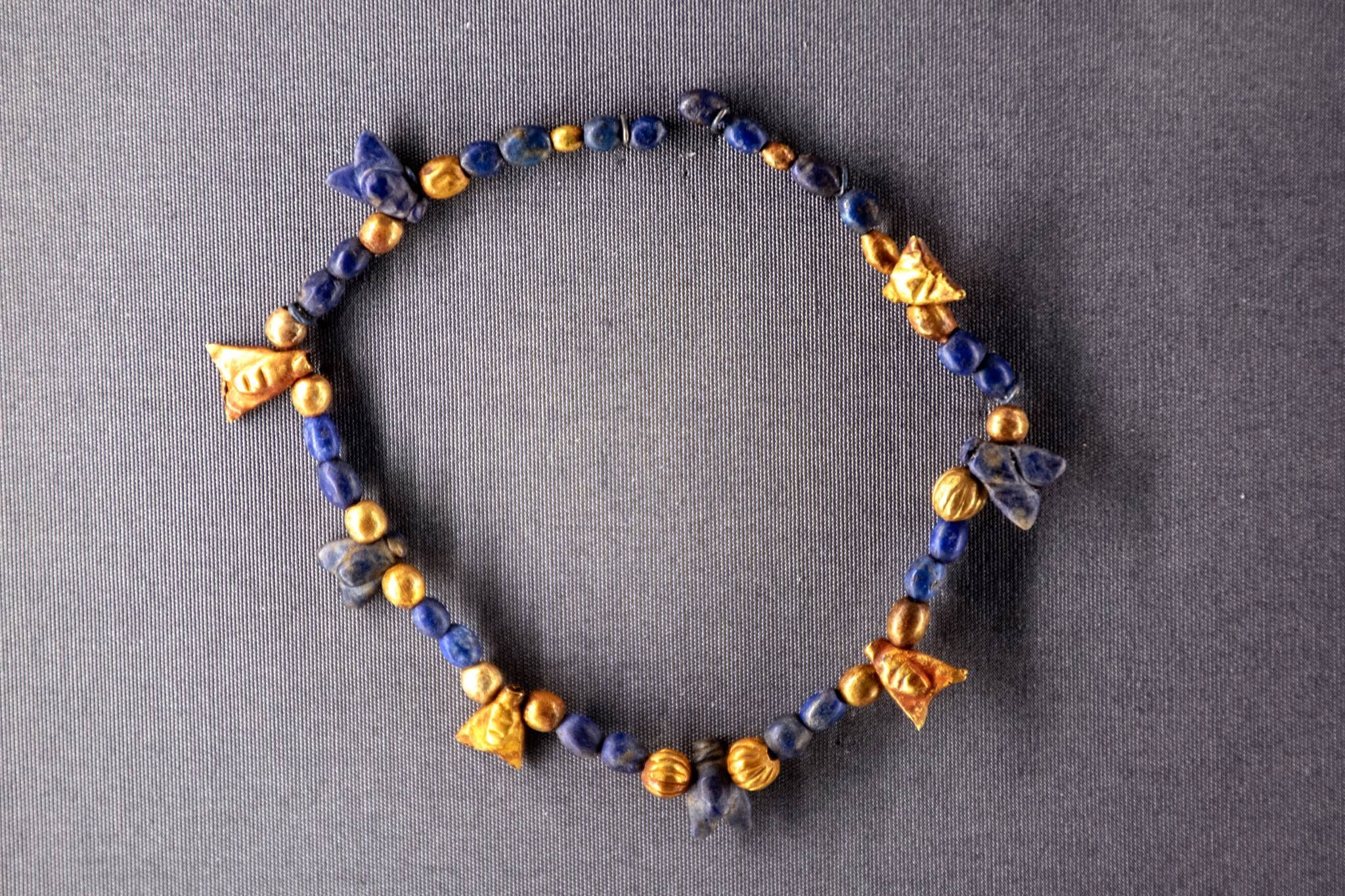
Image Caption: A string of beads from the Royal Cemetery of Ur (ca. 2600 to 2450 BC) garnished with 8 lapis or gold charms in the form of flies. Source: Would you like flies with that? (Penn Museum) [https://www.facebook.com/pennmuseum/photos/would-you-like-flies-with-that-this-string-of-beads-from-the-royal-cemetery-of-u/10156981335674710/] See also Source: Amy Gansell, Beads with fly elements, Ur (Iraq), mid-3rd mill BCE [https://www.pinterest.com/pin/837247386964554325/]
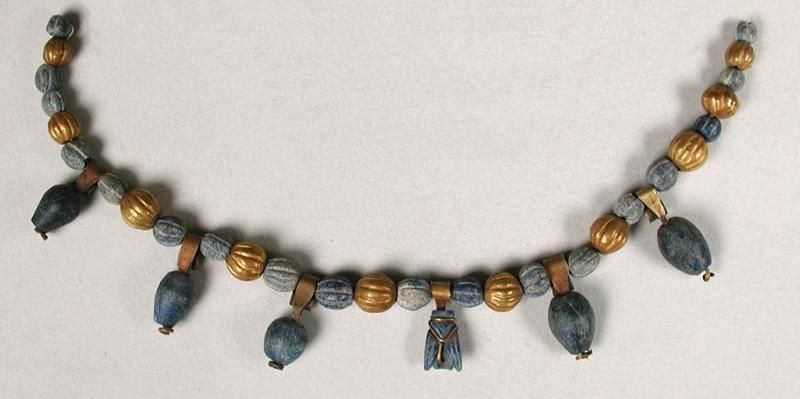
Image Caption: Sumerian necklace. In the center is an amulet in the shape of a fly. Source: Sumerian necklace (Pinterest) [https://www.pinterest.com/pin/496662665132002406/]
The Place of Ugarit (Ras Shamra) in the Levant
Ugarit was a vital Bronze Age port city in the Northern Levant, located in modern-day Syria at Ras Shamra. Situated on the eastern Mediterranean coast, its strategic crossroads location drove immense wealth and prosperity.
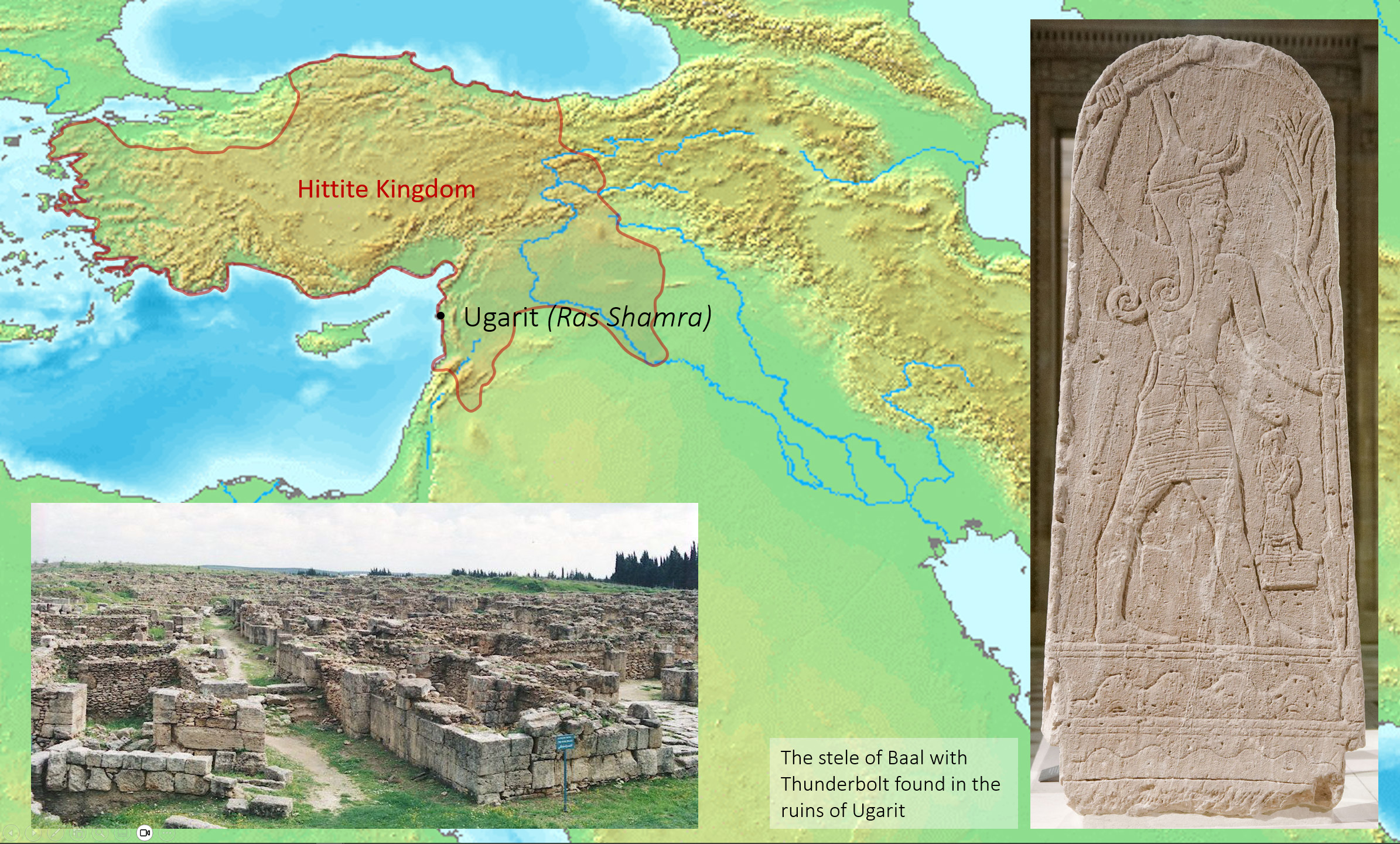
Image Caption: At Ugarit (Ras Shamra) was discovered a Canaanite culture of Baal worshippers. Insets show excavations and the stele of Baal with thunderbolt. Source: Ugarit (Wendag.com) [https://www.wendag.com/forum/forum/literatuur/mitologie/982-ugarit] and Source: Baal with Thunderbolt (Wikipedia) [https://en.wikipedia.org/wiki/Baal_with_Thunderbolt]
Ugarit operated as an affluent, cosmopolitan hub where Egyptian, Mesopotamian, Hittite, and Mycenaean merchants and diplomats converged. Its kingdom's territory spanned 2000 square kilometers, at the junction of crucial trade and travel routes.
- Cultural Borders: Positioned in a fertile region of the Fertile Crescent, Ugarit was bordered to the north by the Hittite Empire and to the southeast by Amurru.
- Trade Crossroads: Ugarit connected north-south maritime and overland routes linking Egypt and Anatolia, as well as east-west routes bridging inner Syria and Mesopotamia with Cyprus and the Aegean.
- Natural Harbors: Ugarit had access to sheltered coastal facilities (e.g., Minet el-Beida).
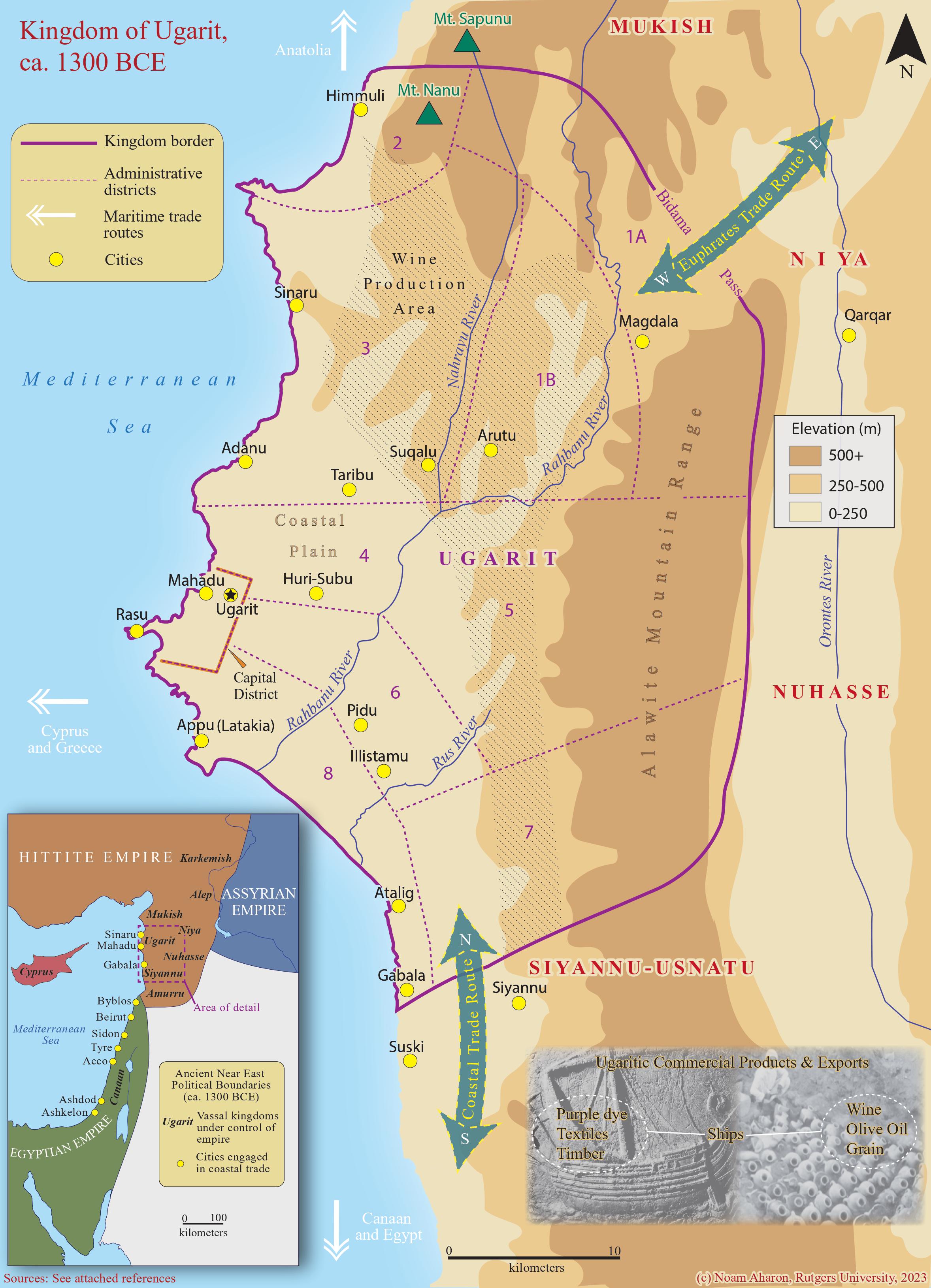 Image Caption: The Kingdom of Ugarit (1300 BC). Source: Ugarit and its Phoenician neighbors (Reddit) [https://www.reddit.com/r/PhoeniciaHistoryFacts/comments/14romx4/ugarit_and_its_phoenician_neighbors/]
Three port cities that served the Kingdom of Ugarit were Minet el-Beida (ancient Mahadu), Ras Ibn Hani, and Gibala (Tell Tweini). The first coastal port sat 1 kilometer from the inland capital, allowing Ugarit to anchor its commercial fleet and so extend its regional land trade out to sea.
Image Caption: The Kingdom of Ugarit (1300 BC). Source: Ugarit and its Phoenician neighbors (Reddit) [https://www.reddit.com/r/PhoeniciaHistoryFacts/comments/14romx4/ugarit_and_its_phoenician_neighbors/]
Three port cities that served the Kingdom of Ugarit were Minet el-Beida (ancient Mahadu), Ras Ibn Hani, and Gibala (Tell Tweini). The first coastal port sat 1 kilometer from the inland capital, allowing Ugarit to anchor its commercial fleet and so extend its regional land trade out to sea.
- Minet el-Beida ('White Port'), once called Mahadu, was the principal maritime harbor for the capital. It was used for trading copper, tin, perfumes, and agricultural goods.
- Ras Ibn Hani, located on a peninsula 10 kilometers southwest, served as a secondary harbor and a royal summer residence. It was the hub for Ugarit’s bronze and dye industries.
- Gibala (Tell Tweini) was positioned some 30 kilometers away at the southernmost edge of Ugarit's kingdom, extending its territorial control and trade.
Ancient Ugarit featured a royal palace, an acropolis with temples dedicated to Baal and Dagan, and densely populated residential areas. It thrived from 1450 BC until its destruction during the Bronze Age Collapse (ca. 1200 BC).
The Relevance of Ugarit (Ras Shamra) to Biblical Culture
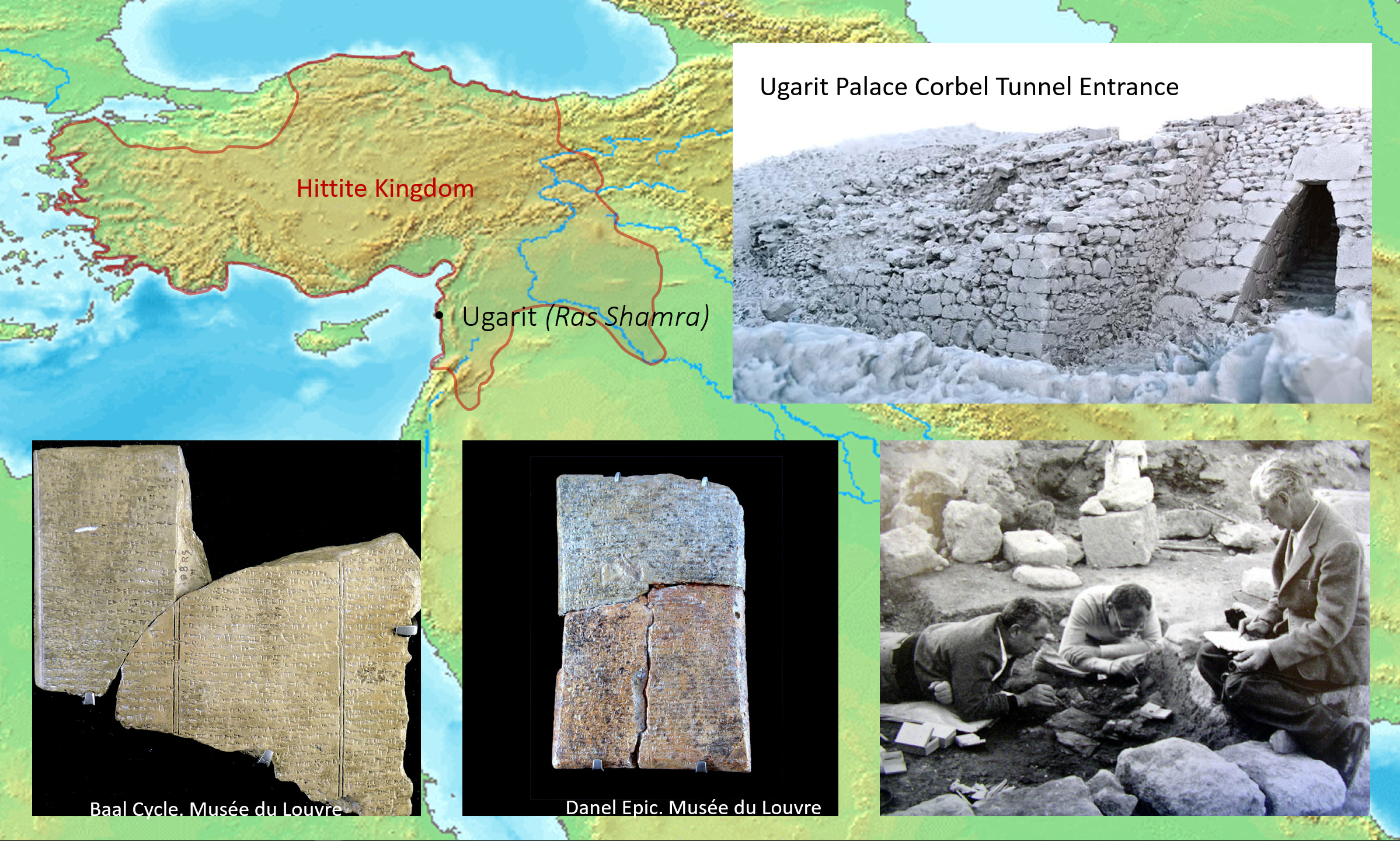
Image Caption: At Ugarit (Ras Shamra) were discovered Hittite building techniques (Corbel tunnel) and hundreds of cuneiform tablets in many languages. Insets show Corbel tunnel entrance, Baal Cycle and Danel epic tablets, and tablet excavators. Source for corbel tunnel: Ugarit (Syrian Heritage) [http://syrianheritagerevival.org/ugarit/]; Source for Baal Cycle tablet: Baal Cycle (Wikipedia) [https://en.wikipedia.org/wiki/Baal_Cycle]; Source for Danel tablet: Danel (Wikipedia) [https://en.wikipedia.org/wiki/Danel]; Source for Claude F.A. Schaeffer with excavators: (Unknown)
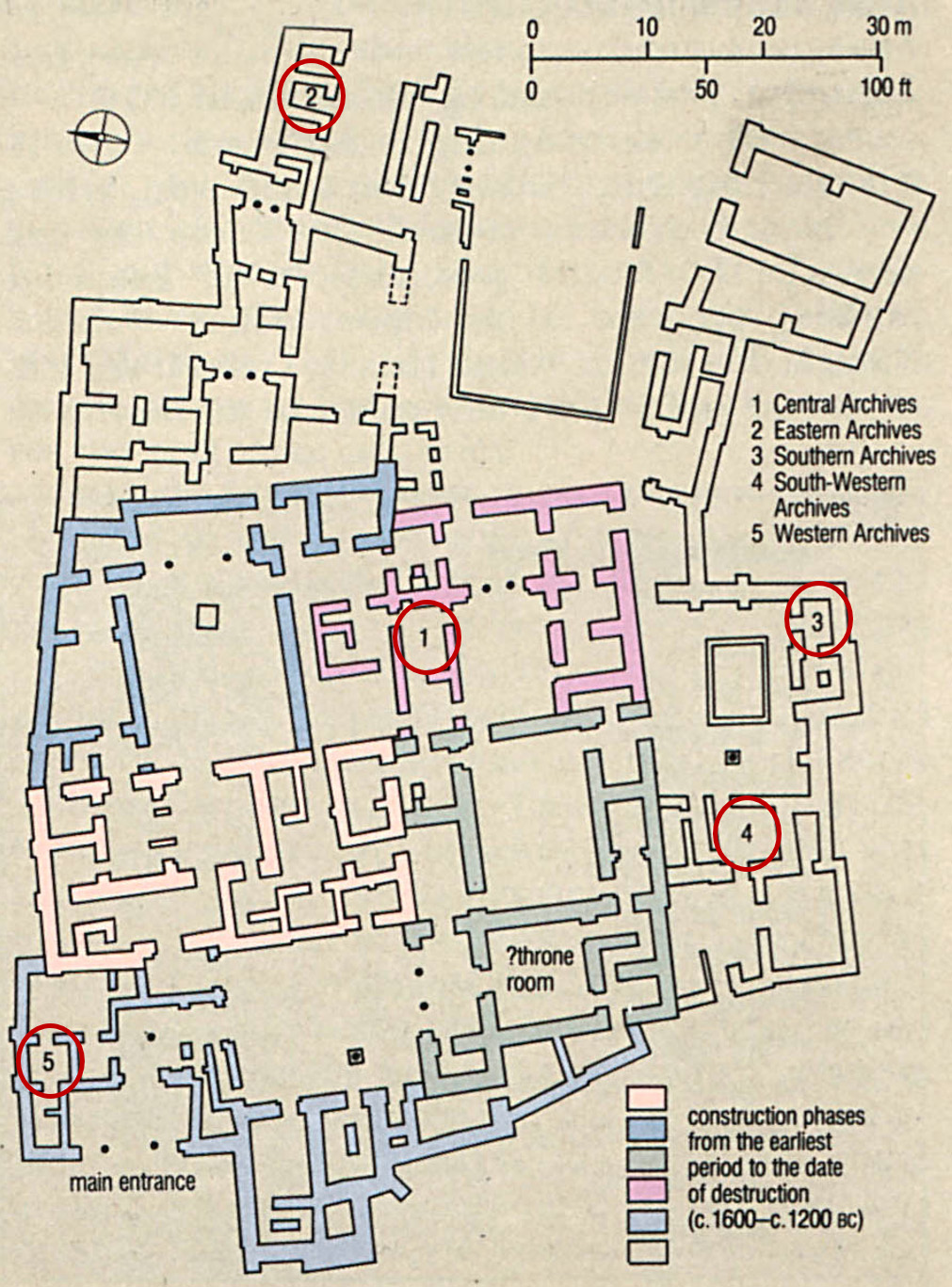 Image Caption: Plan of Ugarit's Royal Palace showing locations where text archives were discovered. Source: (Unknown)
Ugarit is an important archaeological site for biblical studies. Its hundreds of clay tablets, dating to the 13th century BC illuminate the culture, language, and polytheistic religion of Canaanites, offering a counterpoint to Hebrew Bible texts, Hebrew vocabulary, and Israelite monotheism.
Image Caption: Plan of Ugarit's Royal Palace showing locations where text archives were discovered. Source: (Unknown)
Ugarit is an important archaeological site for biblical studies. Its hundreds of clay tablets, dating to the 13th century BC illuminate the culture, language, and polytheistic religion of Canaanites, offering a counterpoint to Hebrew Bible texts, Hebrew vocabulary, and Israelite monotheism.
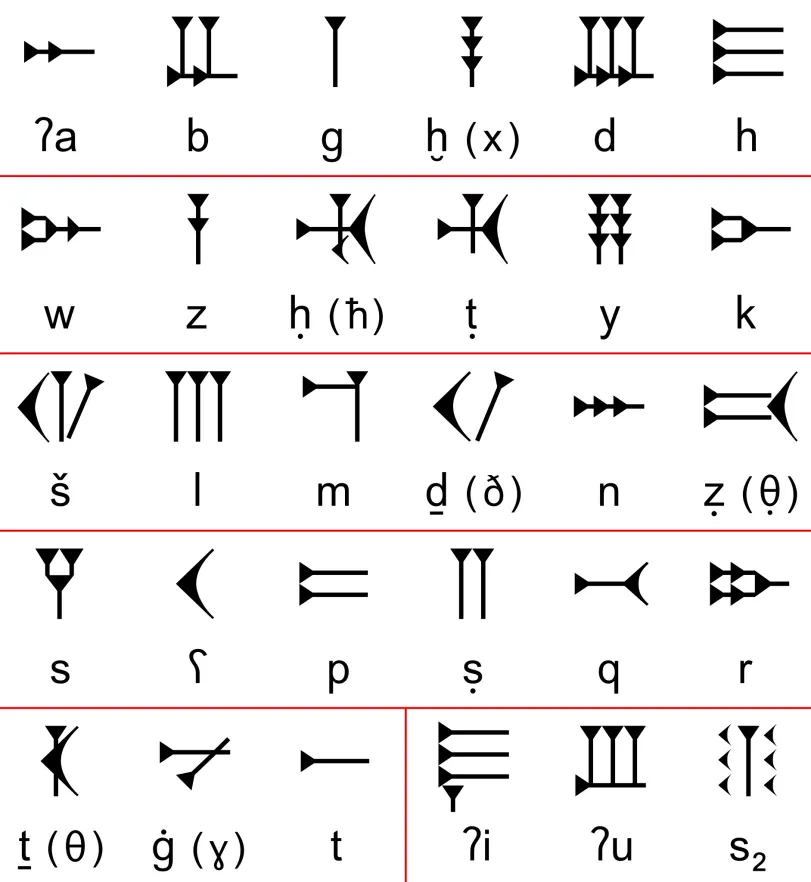 Image Caption: The Ugaritic Cuneiform Alphabet has 30 letters (8 more than Hebrew), two of which are vowels. Source: Philip Boyes, The Social Context of Writing in Ancient Ugarit (The Ancient Near East Today, April 2022, Vol. 10.4) [https://anetoday.org/boyes-writing-ugarit/]
The Ugaritic mostly consonantal alphabet of 30 signs was a writing system invented in the city of Ugarit (Ras Shamra) in the 14th century BC. For the Canaanites, it bridged a gap between Mesopotamian syllabic writing in cuneiform and the linear alphabet in cursive pictographs first used by Semites of Egypt from the 19th to 15th centuries BC (as in the late Bronze Age Lachish alphabetic inscription).
Image Caption: The Ugaritic Cuneiform Alphabet has 30 letters (8 more than Hebrew), two of which are vowels. Source: Philip Boyes, The Social Context of Writing in Ancient Ugarit (The Ancient Near East Today, April 2022, Vol. 10.4) [https://anetoday.org/boyes-writing-ugarit/]
The Ugaritic mostly consonantal alphabet of 30 signs was a writing system invented in the city of Ugarit (Ras Shamra) in the 14th century BC. For the Canaanites, it bridged a gap between Mesopotamian syllabic writing in cuneiform and the linear alphabet in cursive pictographs first used by Semites of Egypt from the 19th to 15th centuries BC (as in the late Bronze Age Lachish alphabetic inscription).
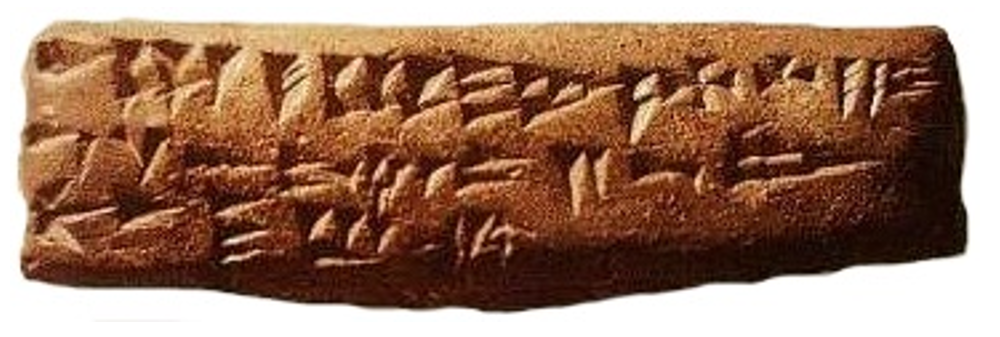 Image Caption: Ugarit alphabet in left to right order. The abecedary tablet is missing 3 letters (š 13th, l 14th, ṯ 25th) at one broken end. Source: Jeff A. Benner, Ugarit and the Bible (Ancient Hebrew Research Center) [https://www.ancient-hebrew.org/biblical-history/ugarit-and-the-bible.htm]
The Ras Shamra archives include texts in 7 languages and scripts (Ugaritic, Akkadian, Sumerian, Hurrian, Cypro-Minoan, Hittite, and Egyptian). The Ugaritic cuneiform alphabet is now attested at sites as far south as Tel Aphek near Tel Aviv. Ugaritic, like Hebrew, is a Northwest Semitic language. Ras Shamra yielded several thousand tablets, including 1400 texts in Ugaritic, Larger archives include the 12–15,000 tablets found at Ebla.
Image Caption: Ugarit alphabet in left to right order. The abecedary tablet is missing 3 letters (š 13th, l 14th, ṯ 25th) at one broken end. Source: Jeff A. Benner, Ugarit and the Bible (Ancient Hebrew Research Center) [https://www.ancient-hebrew.org/biblical-history/ugarit-and-the-bible.htm]
The Ras Shamra archives include texts in 7 languages and scripts (Ugaritic, Akkadian, Sumerian, Hurrian, Cypro-Minoan, Hittite, and Egyptian). The Ugaritic cuneiform alphabet is now attested at sites as far south as Tel Aphek near Tel Aviv. Ugaritic, like Hebrew, is a Northwest Semitic language. Ras Shamra yielded several thousand tablets, including 1400 texts in Ugaritic, Larger archives include the 12–15,000 tablets found at Ebla.
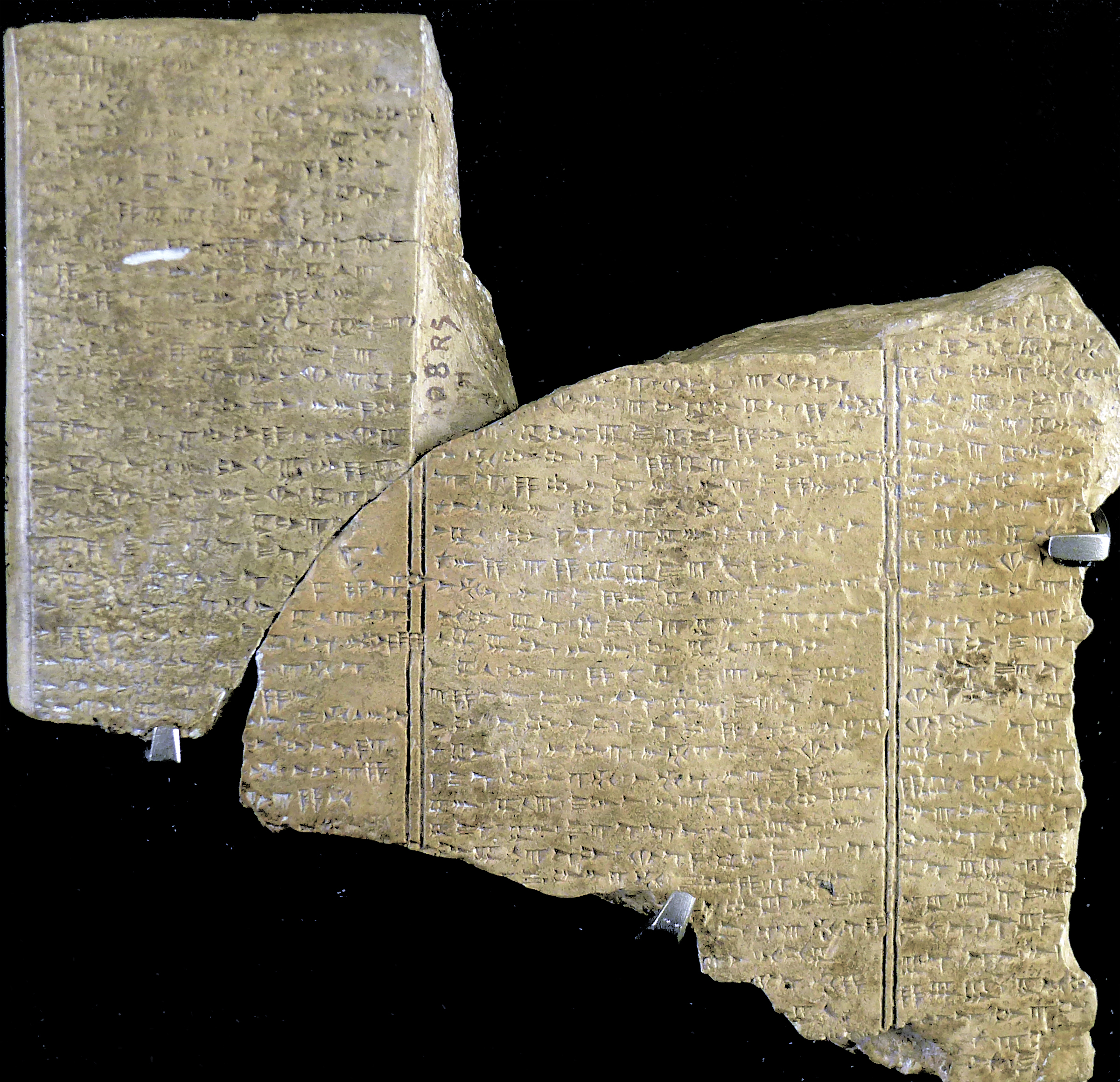 Image Caption: The Baal Cycle tablets bear the most famous of the Ugaritic texts. The Louvre. Source: Ugaritic texts (Wikipedia) [https://en.wikipedia.org/wiki/Ugaritic_texts] and [https://upload.wikimedia.org/wikipedia/commons/d/d1/P1180250_Louvre_Langue_ougaritique_Tablette_poeme_mythologique_AO16641_et_16642_rwk.jpg]
The Ugaritic texts reveal a rich pantheon of gods and goddesses whose worship frequently conflicted with the religion of ancient Israel as described in the Bible:
Image Caption: The Baal Cycle tablets bear the most famous of the Ugaritic texts. The Louvre. Source: Ugaritic texts (Wikipedia) [https://en.wikipedia.org/wiki/Ugaritic_texts] and [https://upload.wikimedia.org/wikipedia/commons/d/d1/P1180250_Louvre_Langue_ougaritique_Tablette_poeme_mythologique_AO16641_et_16642_rwk.jpg]
The Ugaritic texts reveal a rich pantheon of gods and goddesses whose worship frequently conflicted with the religion of ancient Israel as described in the Bible:
- El: The supreme father of the gods in Ugarit, often depicted as sitting on a throne and ruling the divine council. His titles, "Ancient of Days" and "Bull," are applied also to Hebrew YHWH.
- Baal: The storm and fertility god rides the clouds. The Bible often decries Israelite Baal worship, as in the contest at Mount Carmel (1 Kings 18). The role of storm god is also attributed to YHWH (Psalm 29).
- Asherah (Athirat) is the consort of El, as she was of YHWH (per dual orthostats at Arad, cult stand at Kuntillet Ajrud). Worship at "Asherah poles" was condemned by Hebrew prophets.
- The Divine Council: References in the Bible to God's "council" or "assembly" (e.g., Psalm 82) find direct parallels in Ugaritic descriptions of the gods gathered together.
Ras Shamra (Akkadian) Flood Tablet
A Ras Shamra tablet describing the great flood in Akkadian was discovered in the ruins of ancient Ugarit (in Syria). It is a Late Bronze Age version of the Mesopotamian flood myth (ca. 1400 to 1200 BC). It preserves the moment when the gods decide to destroy humanity and the god Ea secretly warns Atrahasis to build a boat to survive.
- Divine Council: The text opens with the gods gathering in counsel, where they make the fateful decision to send a catastrophic flood to wipe out the world.
- Secret Warning: The god of wisdom, Ea (or Enki), objects to the destruction of humanity. Bound by oath to keep the plan secret, Ea finds a clever loophole: he whispers the impending doom directly to a wall, knowing that the flood hero (Atrahasis) is able to overhear on the other side.
- Ark Construction: Instructed by the wall, the hero learns how to construct a massive boat to preserve his family, craftsmen, and all kinds of animals before the flood overwhelms the earth.
The tablet fragment contains only part of the flood story. It's importance lies in the fact that, besides a copy of the Epic of Gilgamesh found in Megiddo (Israel), it is the only other surviving flood account found outside Mesopotamia.
While Ras Shamra is more celebrated for its mythological Baal cycle and early cuneiform alphabet, the flood fragment provides a fascinating link between Canaanite traditions and the Mesopotamian deluge story.
Ras Shamra Flood Story
At Ras Shamra was found A Middle Bronze Age (14th century BC) Akkadian fragment of Atrahasis that mentions the flood (RS 22.421; Jean Nougayrol, “Textes Suméro-Accadiens des Archives et Bibliothèques Privées d’Ugarit,” Ugaritica V, Mission de Ras Shamra, XVI, Paris: P. Geuthner, 1968, 300-304, 441, #167; Lambert and Millard, Atrahasis, 1969, 131–33).
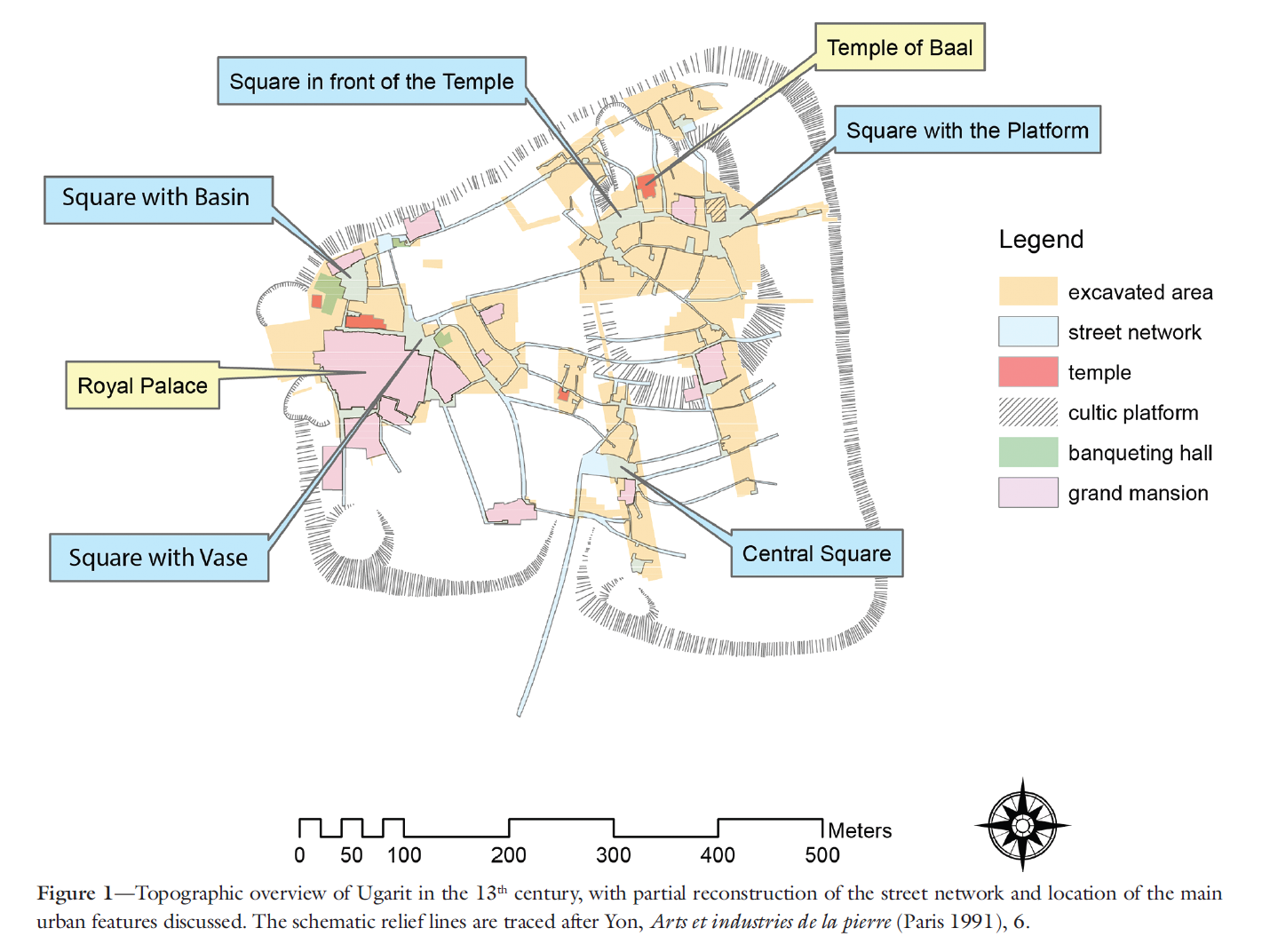 Image Caption: Plan of Ugarit's excavations. Source: Alessandra Gilibert, Urban Squares in Late Bronze Age Ugarit: a Street View on Ancient Near Eastern Governance, Journal of Near Eastern Studies October 2021, vol. 80, no. 2, p. 379 [https://www.journals.uchicago.edu/doi/10.1086/716076]
The Ras Shamra flood tablet was found in the south city trench, near the Central Square, just north of the House of the Tablets (Block X, building B) where many classical school texts were uncovered. Nougayrol, 300, called it “Récit du déluge.”
Image Caption: Plan of Ugarit's excavations. Source: Alessandra Gilibert, Urban Squares in Late Bronze Age Ugarit: a Street View on Ancient Near Eastern Governance, Journal of Near Eastern Studies October 2021, vol. 80, no. 2, p. 379 [https://www.journals.uchicago.edu/doi/10.1086/716076]
The Ras Shamra flood tablet was found in the south city trench, near the Central Square, just north of the House of the Tablets (Block X, building B) where many classical school texts were uncovered. Nougayrol, 300, called it “Récit du déluge.”
This Ras Shamra flood story was written on a single tablet. Only the beginning and end have been preserved. It dates to the Middle Babylonian period, but it may be a copy of an earlier Akkadian version.
The fragment states that Atrahasis lived in the temple of Ea, which implies he was a priest.
The Ras Shamra Akkadian Flood Tablet
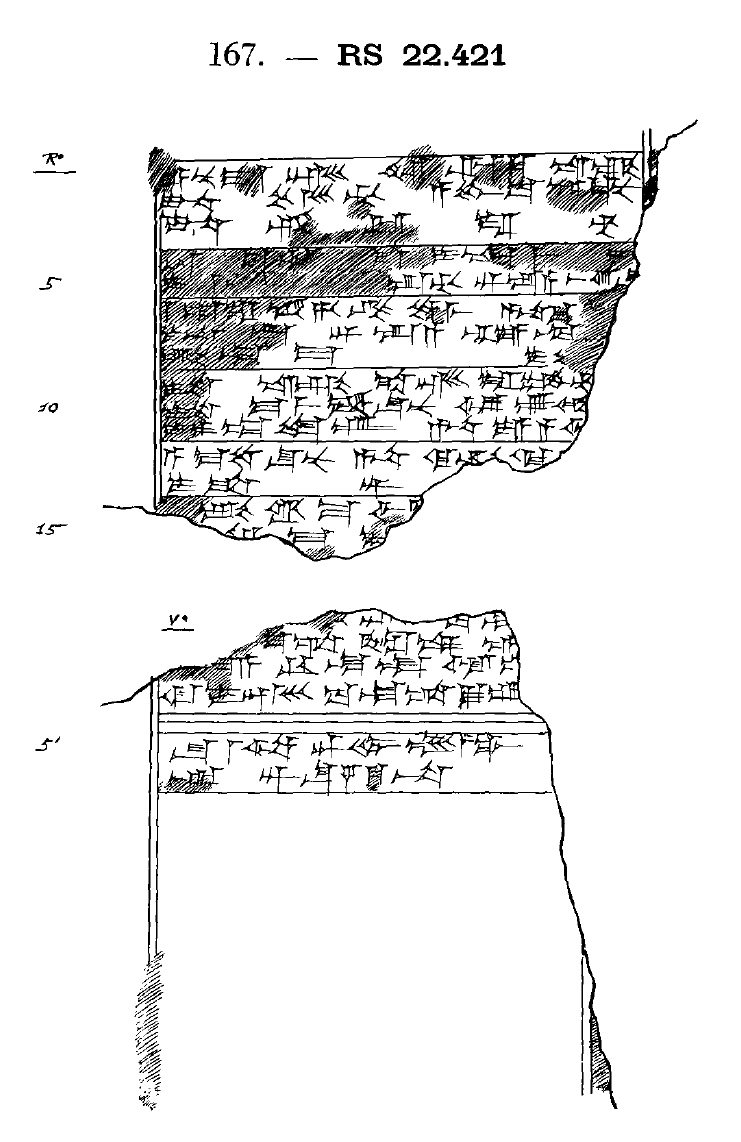
Image Caption: Drawing of the Ras Shamra Akkadian Flood Tablet. Source: Claude F.-A. (Claude Frédéric-Armand) Schaeffer. Ugaritica. V: nouveaux textes accadiens, hourrites et ugaritiques des archives et bibliothèèques privéées d'Ugarit. January 1968. No. 167 [= R.S. 22.421])[https://commons.library.stonybrook.edu/cgi/viewcontent.cgi?article=1051&context=amar]
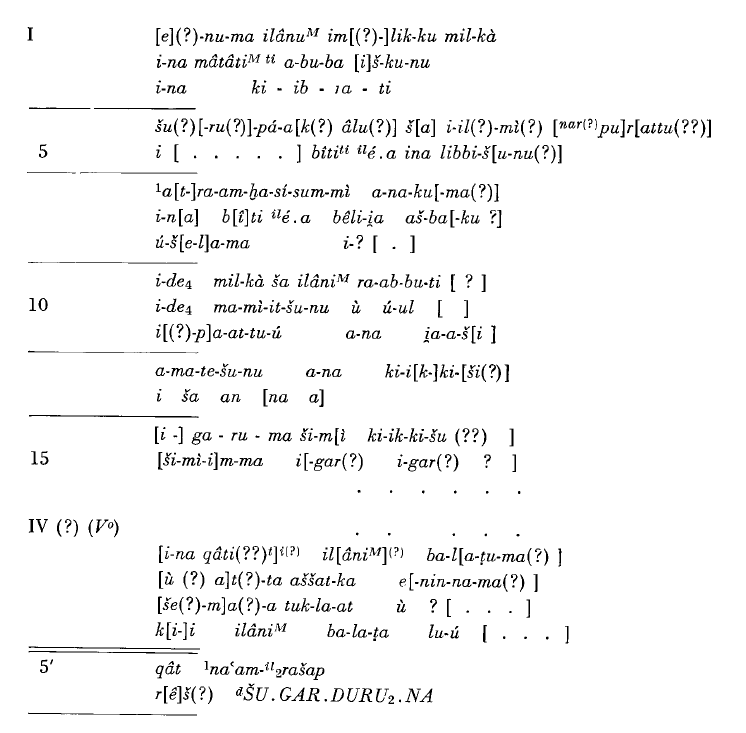
Image Caption: Transcription of the Ras Shamra Akkadian Flood Tablet. Source: Claude F.-A. (Claude Frédéric-Armand) Schaeffer. Ugaritica. V: nouveaux textes accadiens, hourrites et ugaritiques des archives et bibliothèèques privéées d'Ugarit. January 1968. No. 167 [= R.S. 22.421])[https://commons.library.stonybrook.edu/cgi/viewcontent.cgi?article=1051&context=amar]
A Translation of the Ras Shamra Flood Tablet
Obverse
When the gods took counsel in the lands
And brought about a flood in the regions of the world,
. . . . hears [. .] . . . [. . . . ]. . Ea in his heart.
‘I am Atra-hasis, I lived in the temple of Ea, my lord, . . . . . . [.]
I knew the counsel of the great gods,
I knew their oath, though they did not reveal it to me.
He repeated their words to the wall,
“Wall, hear [. . .
Reverse
[. . . .] . the gods life [. . .
[. . . ] . . your wife . [. . .
[. .] . help
and . [. . . life like the gods [you will] indeed [possess].’
Written by Mudammiq-Nergal Property (?) of . . . . . .
Translation: Wilfred G. Lambert, Alan R. Millard, and Miguel Civil, Atra-Hasis: The Babylonian Story of the Flood (Winona Lake, Ind.: Eisenbrauns, 1999), 133; Source: David E. Graves, Bonus 25 — Ras Shamra Tablets (Biblical Archaeology Graves, December 17, 2014) [https://biblicalarchaeologygraves.blogspot.com/2014/12/bonus-25-ras-shamra-tablets.html]
ANE Flood Parallels
Atrahasis Epic parallels Gilgamesh Epic XI
Some sentences of Gilgamesh are almost verbatim from Atrahasis.
| Atrahasis Epic | Gilgamesh Epic XI |
|---|---|
| "Wall, listen to me." Atrahasis III,i,20 | "Wall, pay attention" Gilgamesh XI,22 |
| "Like the apsu you shall roof it" Atrahasis III,i,29 | "Like the apsu you shall roof it" Gilgamesh XI,31 |
| "I cannot live in [your city]" Atrahasis III,i,47 | "I cannot live in your city" Gilgamesh XI,40 |
| "Ninurta went forth making the dikes [overflow]" Atrahasis U rev,14 | "Ninurta went forth making the dikes overflow" Gilgamesh XI,102 |
| "One person could [not] see another" Atrahasis III,iii,13 | "One person could not see another" Gilgamesh XI,111 |
| "For seven days and seven nights came the storm" Atrahasis III,iv,24 | "Six days and seven nights the wind and storm flood" Gilgamesh XI,127 |
| "He offered [a sacrifice]" Atrahasis III,v,31 | "And offered a sacrifice" Gilgamesh XI,155 |
| "the lapis around my neck" Atrahasis III,vi,2 | "the lapis lazuli on my neck" Gilgamesh XI,164 |
| "How did man survive the destruction?" Atrahasis III,vi,10 | "No man was to survive the destruction" Gilgamesh XI,173 |
Gilgamesh XI parallels Genesis 6–9
The order of events in the flood account of Gilgamesh XI parallels that of Genesis 6–9 with one exception. This cannot be coincidence, but indicates a direct literary dependence of the biblical flood account on that of Mesopotamian origin.
| Gilgamesh XI | Genesis 6–9 | |
|---|---|---|
| Divine decision to destroy mankind | Gilg. XI 14-19 | Gen. 6:6-7 |
| Warning to the flood hero | Gilg. XI 20-23 | Gen. 6:13 |
| Command to build boat | Gilg. XI 24-31 | Gen. 6:14-21 |
| Hero's obedience | Gilg. XI 33-85 | Gen. 6:22; 7:5 |
| Command to enter | Gilg. XI 86-88 | Gen. 7:1-3 |
| Entry | Gilg. XI 89-93 | Gen. 7:7-16 |
| Closing of door | Gilg. XI 93 | Gen. 7:16 |
| Description of inundation | Gilg. XI 96-128 | Gen. 7:17-24 |
| Destruction of life | Gilg. XI 133 | Gen. 7:21-22 |
| End of rainfall | Gilg. XI 129-31 | Gen. 8:2-3 |
| Hero opens window [order variation] | Gilg. XI 135 | Gen. 8:6 |
| Ark grounding on mountain | Gilg. XI 140-144 | Gen. 8:4 |
| Bird's reconnaissance | Gilg. XI 145-54 | Gen. 8:6-12 |
| Exit | Gilg. XI 155 | Gen. 8:15-19 |
| Sacrifice | Gilg. XI 155-58 | Gen. 8:20 |
| Divine smelling of sacrifice | Gilg. XI 159-61 | Gen. 8:21-22 |
| Divine blessing on flood hero | Gilg. XI 189-96 | Gen. 9:1-17 |
Hebrew Flood Traditions
Mesopotamian versus Hebrew Flood Traditions
While there can be no doubt of the formal dependence of the Genesis flood story on the flood story of Mesopotamian origin, it is in the differences that we will find the definitive distinctives (and polemic) of the Hebrew culture versus that of its cultural forebears.
| Mesopotamian Traditions | Hebrew Traditions | |
|---|---|---|
| Divine Nature | Multiple gods: angry or fearful | One god (two names): righteous but compassionate |
| Motive for Flood | Enlil: aggravation at human clamor | Elohim: grief at human wickedness |
| Divine Strategy | Gods try to conceal plan to destroy | God reveals plan to destroy |
| Revelation | Through Ea's dream to Atrahasis || Utnapishtim | Through Elohim's oracle to Noah |
| Ark Form | Gilg. XI: cubic; BM Ark Tablet: circular kuphar; BM Imago Mundi Tablet: ribbed | rectangular (300 x 50 x 30 cubits) |
| Ark Crew and Cargo | pilot, craftsmen, hero and his family, pairs of animals | hero and his family, pairs of animals |
| Deluge | Gilg. XI: storm lasts 6 days and 7 nights | 7-day warning; storm lasts 40 days and nights |
| Bird Reconnaisance | dove, swallow, raven | raven, 3 doves |
| Ark Landing | Mount Nisir | Mount Ararat |
| Covenant & Signet | Grief signified by mother-goddess Beletili's fly-beads | Grace signified by God's bow in the sky |
The biblical flood account (Genesis 6–9), while borrowing the Mesopotamian story framework — a global deluge, a divinely planned ark, a bird reconnaissance — contrasts with Babylonian theology by replacing capricious, dependent deities with the one moral, omnipotent judge of mankind. The Genesis flood account functions as a polemic in several ways:
- Just Remorse versus Selfish Motive for the Flood: In Mesopotamian epics, the gods send the flood for selfish reasons (humans were too numerous or noisy and kept gods from sleeping). Genesis depicts the flood as God's remorseful yet just response to human corruption and violence. It models divine justice and human moral accountability.
- Moral Qualification versus Favoritism When Choosing a Hero: The Babylonian flood hero is saved because Ea bends his oath of secrecy by a loophole to rescue his favorite. In the biblical account, God grants Noah exception because he is 'righteous and blameless' in his generation.
- Noble Resolve versus Cowardice When Executing Judgment: In the Atrahasis myth, the gods are terrified of the flood-storm they created, cowering like dogs because their food sources (human sacrifices and offerings) have been wiped out. In contrast, the biblical God is self-existent and resolute, needing nothing from humanity but remorsefully intent on destroying the sinful world he created.
- Compassion versus Remorse as a Motive for Reconciliation: Mesopotamian gods regret the impulsivity of their edict to destroy mankind, so they promise never to act as recklessly again. God in Genesis replaces his own remorse at forming relentlessly sinful humanity with compassion on humanity's helplessly sinful condition, sealing his covenant with the rainbow.
Hebrew Tribal Flood Traditions
In the Genesis flood story (Genesis 6–9), the text alternates between two divine names: YHWH and Elohim. The segmentation of the Genesis flood story marked by alternating uses of these divine names is readily discernible. It may be that these divine names are but vestigial traces of once distinct written accounts that later came to be merged to form Genesis 6–9.
Genesis 6
- YHWH appears in verses 1–8. YHWH sees the wickedness of humanity, expresses grief over creating Man, limits human life to 120 years, and declares his intention to blot out all living things. But Noah finds favor in the eyes of YHWH.
- Elohim appears in verses 9–22. The text reintroduces Noah as a righteous man who walked with Elohim. Elohim views a corrupt, violent world and gives Noah precise instructions to build an ark, specifying overall dimensions and animals to bring aboard.
Genesis 7
- YHWH appears in verses 1–5. YHWH speaks to Noah directly, telling him to enter the ark and commanding him to take seven pairs of clean animals and birds, but only one pair of unclean animals.
- Elohim appears in verses 6–16a. The text notes Noah’s age (600 years) and records the animals entering the ark in pairs (male and female), as Elohim had commanded Noah.
- YHWH appears in verse 16 ("And YHWH shut him in"). This brief transition highlights a personal, protective action by YHWH to seal the door behind Noah.
Genesis 8
- Elohim appears in verses 1–19. Elohim 'remembers' Noah, sends a wind to make the waters recede, and determines the months and days the ark rests on Mount Ararat. Finally, Elohim commands Noah to leave the ark.
- YHWH appears in verses 20–22. Once on dry land, Noah builds an altar to YHWH and offers burnt sacrifices of clean animals. YHWH smells the soothing aroma and vows in his heart never again to curse the ground or destroy all living creatures because of human wickedness.
Genesis 9
- Elohim appears in verses 1–17. Elohim blesses Noah’s family, establishes dietary and moral laws regarding lifeblood, and signifies an everlasting covenant with humanity and all living creatures by setting a rainbow in the clouds.
Genesis 6:9 to 9:29 Destruction of Nature
tôledôṯ of Noah
Genre and Aim
The concentric flood account of Genesis 6:9 to 9:19, as well as the exposition (6:1-8) and resolution (9:20-29) narratives that frame it, is a cosmological judgment account. It is the first of two catastrophe accounts (against cosmos/nature and society).
Continuing Motifs of Blessing and Cursing
The flood account entails both cursing and blessing.
Initially, it appears that the account is, overall, a primeval account of a catastrophic judgment (i.e., the flood) with which YHWH/God cursed the ground. This accounts for the overarching form of 6:9–9:19.
However, after the catastrophic judgment, comes an account of the restoration of post-diluvian humanity, when YHWH/God:
- rescinds the curse of the flood,
- blesses Noah and his offspring, and
- establishes his covenant with Noah, his offspring and all life upon the earth.
These three distinct divine 'blessings' are presented in the form of three divine utterances, the first two of which include 'poetic edicts' (8:22; 9:6).
First, 'YHWH' rescinds the curse of the flood whereby he cursed the ground (8:21 [cf. 5:29], 22).
Second, 'God' blesses Noah and his offspring with a restatement of the primordial blessing made upon primordial humanity (9:1, 2-3, 4, 5-6, 7):
- 9:1 and 9:7 form an inclusio about this section and hark back to Gen. 1:28
- 9:2-3, while harking back to the succeeding concern with food in Gen. 1:29-30, extend the rights of humanity to kill animals for food
- 9:4 sets a prohibition on eating animal blood
- 9:5-6 establish the right of executing capital punishment so as to protect the sanctity of human life, which is uniquely made in the image of God, thus curbing a human tendency, characteristic of the line of Cain, to commit murder
Third, 'God' establishes his covenant with Noah, his offspring and all life upon the earth never again to destroy nature by a flood — a covenant symbolized by the sign of the rainbow (9:9-17).
Yet, even in the wake of YHWH/God's threefold blessing on Noah, his offspring and all living animals, the denouement of 9:20-29 issues in a contrast between Noah's (not YHWH/God's directly) curse upon Canaan (9:25) — a significant foreshadowing of the command to expel the Canaanites from the land promised to Abram — and Noah's blessing upon the lines of Japheth and, especially, Shem (9:26-27). Indeed, Noah's words in 9:25-27 join those of YHWH/God in 8:22 and 9:6 as comprising another example of a 'poetic edict' in this account. The denouement ends with the genealogical summation that Noah lived after the flood 350 years, and all his lifetime lasted 950 years (9:28-29).
Assymetrical Concentric Patterning
Genesis 6:9 to 9:19 is the first narrative in the book whose elements have been arranged according to a concentric pattern, meaning its form comprises a series of enveloping parallels, each set of parallels nested within another, like the nesting of Chinese dolls. Almost all the subsequent narratives and/or sagas of the book will follow this pattern.
Yet the structure of this section is not entirely symmetrical. It is formed of simple parallel frames, but it also holds complex frames (made of triadic [three-part] and quadratic [four-part] parallels). That said, the overall form is nonetheless concentric, focusing our attention on the event at the center, the axis: 'and God remembered Noah' (Genesis 8:1).
tôledôṯ of Noah (Cont'd)
Rhetoric of Assymmetry & Irony
The structure of the flood story of Genesis is assymmetrical yet concentric, but it's also ironic — focusing on the irony of the turning event at the center, when YHWH remembers Noah (Genesis 8:1). Prior to that, there is the escalation of divine judgment on the world; after that, there is decreasing divine wrath and increasing divine compassion.
If we include Genesis 6:1-8, the exposition that precedes the tôledôṯ header of 6:9a, there is also a reversal of YHWH's disposition from one of remorseful judgment to one of compassionate grace, which expresses the foremost irony of the divine–human relationship: that the very reason for bringing destruction on humans, namely, their perpetual inclination to do evil, becomes by means of sacrifice, the reason for promising lasting compassion through an eternal covenant, whose seal is the enduring rainbow (Genesis 6:5-7 [YHWH]; 6:11-13 [Elohim]; 8:20-22 [YHWH]; 9:12-17 [Elohim]).
Complex Frameworking Structure
Tiers A B ∥ Ai Aii Bi Bii
Genesis 6:9-10
| A ט אֵלֶּה תּוֹלְדֹת נֹחַ--נֹחַ אִישׁ צַדִּיק תָּמִים הָיָה, בְּדֹרֹתָיו: אֶת-הָאֱלֹהִים, הִתְהַלֶּךְ-נֹחַ. | 9 These are the generations of Noah. Noah was a righteous and blameless man in his generations; Noah walked with God. |
| Bαβ י וַיּוֹלֶד נֹחַ, שְׁלֹשָׁה בָנִים--אֶת-שֵׁם, אֶת-חָם וְאֶת-יָפֶת. | 10 And Noah begot three sons, Shem, Ham, and Japheth. |
Genesis 9:1, 7, 18-19
| Ai א וַיְבָרֶךְ אֱלֹהִים, אֶת-נֹחַ וְאֶת-בָּנָיו; וַיֹּאמֶר לָהֶם פְּרוּ וּרְבוּ, וּמִלְאוּ אֶת-הָאָרֶץ. | 1 And God blessed Noah and his sons, and said to them: 'Be fruitful and multiply, and replenish the earth. |
| … | |
| Aii ז וְאַתֶּם, פְּרוּ וּרְבוּ; שִׁרְצוּ בָאָרֶץ, וּרְבוּ-בָהּ. {ס} | 7 But as for you, be fruitful, and multiply; swarm in the earth, and multiply in it.' {S} |
| … |
| Biβ יח וַיִּהְיוּ בְנֵי-נֹחַ, הַיֹּצְאִים מִן-הַתֵּבָה--שֵׁם, וְחָם וָיָפֶת; וְחָם, הוּא אֲבִי כְנָעַן. | 18 And the sons of Noah, that went forth from the ark, were Shem, and Ham, and Japheth; and Ham is the father of Canaan. |
| Biα יט שְׁלֹשָׁה אֵלֶּה, בְּנֵי-נֹחַ; וּמֵאֵלֶּה, נָפְצָה כָל-הָאָרֶץ. | 19 These three were the sons of Noah, and from these was the whole earth overspread. |
Tiers C ∥ Ci
Genesis 6:11-13
| Cαβ יא וַתִּשָּׁחֵת הָאָרֶץ לִפְנֵי הָאֱלֹהִים; וַתִּמָּלֵא הָאָרֶץ חָמָס. | 11 And the earth was corrupt before God, and the earth was filled with violence. |
| Cαα יב וַיַּרְא אֱלֹהִים אֶת-הָאָרֶץ וְהִנֵּה נִשְׁחָתָה: כִּי-הִשְׁחִית כָּל-בָּשָׂר אֶת-דַּרְכּוֹ עַל-הָאָרֶץ. {ס} | 12 And God saw the earth, and, behold, it was corrupt; for all flesh had corrupted their way on the earth. {S} |
| Cβγ יג וַיֹּאמֶר אֱלֹהִים לְנֹחַ, קֵץ כָּל-בָּשָׂר בָּא לְפָנַי--כִּי-מָלְאָה הָאָרֶץ חָמָס, מִפְּנֵיהֶם; וְהִנְנִי מַשְׁחִיתָם, אֶת-הָאָרֶץ. | 13 And God said to Noah: 'The end of all flesh is come before Me; for the earth is filled with violence through them; and, behold, I will destroy them with the earth. |
Genesis 8:21-22
| Ciγα כא וַיָּרַח יְהוָה אֶת-רֵיחַ הַנִּיחֹחַ וַיֹּאמֶר יְהוָה אֶל-לִבּוֹ לֹא-אֹסִף לְקַלֵּל עוֹד אֶת-הָאֲדָמָה בַּעֲבוּר הָאָדָם, כִּי יֵצֶר לֵב הָאָדָם רַע מִנְּעֻרָיו; וְלֹא-אֹסִף עוֹד לְהַכּוֹת אֶת-כָּל-חַי, כַּאֲשֶׁר עָשִׂיתִי. | 21 And YHWH smelled the sweet savor; and YHWH said in His heart: 'I will not again curse the ground any more for man's sake; for the imagination of man's heart is evil from his youth; neither will I again smite everything living, as I have done. |
| כב עֹד כָּל-יְמֵי הָאָרֶץ: זֶרַע וְקָצִיר וְקֹר וָחֹם וְקַיִץ וָחֹרֶף, וְיוֹם וָלַיְלָה--לֹא יִשְׁבֹּתוּ. | 22 While the earth remains, seedtime and harvest, and cold and heat, and summer and winter, and day and night shall not cease.' |
Tiers D Di ∥ Dii
Genesis 6:14-16, 22
| D יד עֲשֵׂה לְךָ תֵּבַת עֲצֵי-גֹפֶר, קִנִּים תַּעֲשֶׂה אֶת-הַתֵּבָה; וְכָפַרְתָּ אֹתָהּ מִבַּיִת וּמִחוּץ בַּכֹּפֶר. | 14 Make yourself an ark of gopher wood; with rooms you shall make the ark, and shall pitch it within and without with pitch. |
| טו וְזֶה אֲשֶׁר תַּעֲשֶׂה אֹתָהּ: שְׁלֹשׁ מֵאוֹת אַמָּה, אֹרֶךְ הַתֵּבָה, חֲמִשִּׁים אַמָּה רָחְבָּהּ, וּשְׁלֹשִׁים אַמָּה קוֹמָתָהּ. | 15 And this is how you shall make it: the length of the ark three hundred cubits, the breadth of it fifty cubits, and the height of it thirty cubits. |
| טז צֹהַר תַּעֲשֶׂה לַתֵּבָה וְאֶל-אַמָּה תְּכַלֶּנָּה מִלְמַעְלָה, וּפֶתַח הַתֵּבָה, בְּצִדָּהּ תָּשִׂים; תַּחְתִּיִּם שְׁנִיִּם וּשְׁלִשִׁים תַּעֲשֶׂהָ. | 16 A light shall you make for the ark, and to a cubit shall you finish it upward; and the door of the ark shall you set in the side thereof; with lower, second, and third stories shall you make it. |
| … | |
| Di כב וַיַּעַשׂ נֹחַ: כְּכֹל אֲשֶׁר צִוָּה אֹתוֹ, אֱלֹהִים--כֵּן עָשָׂה. | 22 Thus did Noah; according to all that God commanded him, so did he. |
Genesis 8:20
| Dii כ וַיִּבֶן נֹחַ מִזְבֵּחַ, לַיהוָה; וַיִּקַּח מִכֹּל הַבְּהֵמָה הַטְּהֹרָה, וּמִכֹּל הָעוֹף הַטָּהוֹר, וַיַּעַל עֹלֹת, בַּמִּזְבֵּחַ. | 20 And Noah built an altar to YHWH; and took of every clean beast, and of every clean fowl, and offered burnt-offerings on the altar. |
Tiers E ∥ Ei
Genesis 6:17
| E יז וַאֲנִי הִנְנִי מֵבִיא אֶת-הַמַּבּוּל מַיִם עַל-הָאָרֶץ, לְשַׁחֵת כָּל-בָּשָׂר אֲשֶׁר-בּוֹ רוּחַ חַיִּים, מִתַּחַת הַשָּׁמָיִם: כֹּל אֲשֶׁר-בָּאָרֶץ, יִגְוָע. | 17 And as for me, look, I am bringing the flood of waters on the earth, to destroy all flesh, wherein is the breath of life, from under heaven; every thing that is in the earth shall perish. |
Genesis 9:11-17
| Ei יא וַהֲקִמֹתִי אֶת-בְּרִיתִי אִתְּכֶם, וְלֹא-יִכָּרֵת כָּל-בָּשָׂר עוֹד מִמֵּי הַמַּבּוּל; וְלֹא-יִהְיֶה עוֹד מַבּוּל, לְשַׁחֵת הָאָרֶץ. | 11 And I will establish My covenant with you; neither shall all flesh be cut off any more by the waters of the flood; neither shall there any more be a flood to destroy the earth.' |
| יב וַיֹּאמֶר אֱלֹהִים, זֹאת אוֹת-הַבְּרִית אֲשֶׁר-אֲנִי נֹתֵן בֵּינִי וּבֵינֵיכֶם, וּבֵין כָּל-נֶפֶשׁ חַיָּה, אֲשֶׁר אִתְּכֶם--לְדֹרֹת, עוֹלָם. | 12 And God said: 'This is the sign of the covenant that I make between Me and you and every living creature that is with you, for perpetual generations: |
| יג אֶת-קַשְׁתִּי נָתַתִּי בֶּעָנָן; וְהָיְתָה לְאוֹת בְּרִית בֵּינִי וּבֵין הָאָרֶץ. | 13 I have set My bow in the cloud, and it shall be for a sign of a covenant between Me and the earth. |
| יד וְהָיָה בְּעַנְנִי עָנָן עַל-הָאָרֶץ, וְנִרְאֲתָה הַקֶּשֶׁת בֶּעָנָן. | 14 And it shall come to pass, when I bring clouds over the earth, and the bow is seen in the cloud, |
| טו וְזָכַרְתִּי אֶת-בְּרִיתִי, אֲשֶׁר בֵּינִי וּבֵינֵיכֶם, וּבֵין כָּל-נֶפֶשׁ חַיָּה, בְּכָל-בָּשָׂר; וְלֹא-יִהְיֶה עוֹד הַמַּיִם לְמַבּוּל, לְשַׁחֵת כָּל-בָּשָׂר. | 15 that I will remember My covenant, which is between Me and you and every living creature of all flesh; and the waters shall no more become a flood to destroy all flesh. |
| טז וְהָיְתָה הַקֶּשֶׁת בֶּעָנָן; וּרְאִיתִיהָ, לִזְכֹּר בְּרִית עוֹלָם בֵּין אֱלֹהִים, וּבֵין כָּל-נֶפֶשׁ חַיָּה בְּכָל-בָּשָׂר אֲשֶׁר עַל-הָאָרֶץ. | 16 And the bow shall be in the cloud; and I will look on it, that I may remember the everlasting covenant between God and every living creature of all flesh that is on the earth.' |
| יז וַיֹּאמֶר אֱלֹהִים, אֶל-נֹחַ: זֹאת אוֹת-הַבְּרִית, אֲשֶׁר הֲקִמֹתִי, בֵּינִי, וּבֵין כָּל-בָּשָׂר אֲשֶׁר עַל-הָאָרֶץ. {פ} | 17 And God said to Noah: 'This is the sign of the covenant that I have established between Me and all flesh that is on the earth.' {P} |
Tiers F ∥ Fi
Genesis 6:18-20
| F יח וַהֲקִמֹתִי אֶת-בְּרִיתִי, אִתָּךְ; וּבָאתָ, אֶל-הַתֵּבָה--אַתָּה, וּבָנֶיךָ וְאִשְׁתְּךָ וּנְשֵׁי-בָנֶיךָ אִתָּךְ. | 18 But I will establish My covenant with you; and you shall come into the ark, you, and your sons, and your wife, and your sons' wives with you. |
| יט וּמִכָּל-הָחַי מִכָּל-בָּשָׂר שְׁנַיִם מִכֹּל, תָּבִיא אֶל-הַתֵּבָה--לְהַחֲיֹת אִתָּךְ: זָכָר וּנְקֵבָה, יִהְיוּ. | 19 And of every living thing of all flesh, two of every sort shall you bring into the ark, to keep them alive with you; they shall be male and female. |
| כ מֵהָעוֹף לְמִינֵהוּ, וּמִן-הַבְּהֵמָה לְמִינָהּ, מִכֹּל רֶמֶשׂ הָאֲדָמָה, לְמִינֵהוּ--שְׁנַיִם מִכֹּל יָבֹאוּ אֵלֶיךָ, לְהַחֲיוֹת. | 20 Of the fowl after their kind, and of the cattle after their kind, of every creeping thing of the ground after its kind, two of every sort shall come to you, to keep them alive. |
Genesis 9:8-10
| Fi א וַיֹּאמֶר אֱלֹהִים אֶל-נֹחַ, וְאֶל-בָּנָיו אִתּוֹ לֵאמֹר. | 8 And God spoke to Noah, and to his sons with him, saying: |
| ט וַאֲנִי, הִנְנִי מֵקִים אֶת-בְּרִיתִי אִתְּכֶם, וְאֶת-זַרְעֲכֶם אַחֲרֵיכֶם. | 9 'As for Me, look, I establish My covenant with you, and with your seed after you; |
| י וְאֵת כָּל-נֶפֶשׁ הַחַיָּה אֲשֶׁר אִתְּכֶם, בָּעוֹף בַּבְּהֵמָה וּבְכָל-חַיַּת הָאָרֶץ אִתְּכֶם; מִכֹּל יֹצְאֵי הַתֵּבָה, לְכֹל חַיַּת הָאָרֶץ. | 10 and with every living creature that is with you, the fowl, the cattle, and every beast of the earth with you; of all that go out of the ark, even every beast of the earth. |
Tiers G ∥ Gi
Genesis 6:21
| G כא וְאַתָּה קַח-לְךָ, מִכָּל-מַאֲכָל אֲשֶׁר יֵאָכֵל, וְאָסַפְתָּ, אֵלֶיךָ; וְהָיָה לְךָ וְלָהֶם לְאָכְלָה. | 21 And take for yourself of all food that is eaten, and gather it to you; and it shall be for food for you and for them.' |
Genesis 9:2-6
| Gi ב וּמוֹרַאֲכֶם וְחִתְּכֶם, יִהְיֶה, עַל כָּל-חַיַּת הָאָרֶץ, וְעַל כָּל-עוֹף הַשָּׁמָיִם; בְּכֹל אֲשֶׁר תִּרְמֹשׂ הָאֲדָמָה וּבְכָל-דְּגֵי הַיָּם, בְּיֶדְכֶם נִתָּנוּ. | 2 And the fear of you and the dread of you shall be on every beast of the earth, and on every fowl of the air, and on all wherewith the ground teems, and on all the fishes of the sea: into your hand are they given. |
| ג כָּל-רֶמֶשׂ אֲשֶׁר הוּא-חַי, לָכֶם יִהְיֶה לְאָכְלָה: כְּיֶרֶק עֵשֶׂב, נָתַתִּי לָכֶם אֶת-כֹּל. | 3 Every moving thing that lives shall be for food for you; as the green herb have I given you all. |
| ד אַךְ-בָּשָׂר, בְּנַפְשׁוֹ דָמוֹ לֹא תֹאכֵלוּ. | 4 Only flesh with its life, its blood, you shall not eat. |
| ה וְאַךְ אֶת-דִּמְכֶם לְנַפְשֹׁתֵיכֶם אֶדְרֹשׁ, מִיַּד כָּל-חַיָּה אֶדְרְשֶׁנּוּ; וּמִיַּד הָאָדָם, מִיַּד אִישׁ אָחִיו--אֶדְרֹשׁ אֶת-נֶפֶשׁ הָאָדָם. | 5 And surely your blood for your lives will I require; from every beast will I require it; and from man, even from every man's brother, I will require the life of man. |
| ו שֹׁפֵךְ דַּם הָאָדָם, בָּאָדָם דָּמוֹ יִשָּׁפֵךְ: כִּי בְּצֶלֶם אֱלֹהִים, עָשָׂה אֶת-הָאָדָם. | 6 One who sheds man's blood, by man shall his blood be shed; for in the image of God He made man. |
Tiers H Hi ∥ Hii
Genesis 7:1-3, 7-9
| H א וַיֹּאמֶר יְהוָה לְנֹחַ, בֹּא-אַתָּה וְכָל-בֵּיתְךָ אֶל-הַתֵּבָה: כִּי-אֹתְךָ רָאִיתִי צַדִּיק לְפָנַי, בַּדּוֹר הַזֶּה. | 1 And YHWH said to Noah: 'Come you and all your house into the ark; for you have I seen righteous before Me in this generation. |
| ב מִכֹּל הַבְּהֵמָה הַטְּהוֹרָה, תִּקַּח-לְךָ שִׁבְעָה שִׁבְעָה--אִישׁ וְאִשְׁתּוֹ; וּמִן-הַבְּהֵמָה אֲשֶׁר לֹא טְהֹרָה הִוא, שְׁנַיִם--אִישׁ וְאִשְׁתּוֹ. | 2 Of every clean beast you shall take to you seven and seven, each with his mate; and of the beasts that are not clean two [and two], each with his mate; |
| ג גַּם מֵעוֹף הַשָּׁמַיִם שִׁבְעָה שִׁבְעָה, זָכָר וּנְקֵבָה, לְחַיּוֹת זֶרַע, עַל-פְּנֵי כָל-הָאָרֶץ. | 3 of the fowl also of the air, seven and seven, male and female; to keep seed alive on the face of all the earth. |
| … | |
| Hi ז וַיָּבֹא נֹחַ, וּבָנָיו וְאִשְׁתּוֹ וּנְשֵׁי-בָנָיו אִתּוֹ--אֶל-הַתֵּבָה: מִפְּנֵי, מֵי הַמַּבּוּל. | 7 And Noah went in, and his sons, and his wife, and his sons' wives with him, into the ark, because of the waters of the flood. |
| ח מִן-הַבְּהֵמָה, הַטְּהוֹרָה, וּמִן-הַבְּהֵמָה, אֲשֶׁר אֵינֶנָּה טְהֹרָה; וּמִן-הָעוֹף--וְכֹל אֲשֶׁר-רֹמֵשׂ, עַל-הָאֲדָמָה. | 8 Of clean beasts, and of beasts that are not clean, and of fowls, and of every thing that creepeth upon the ground, |
| ט שְׁנַיִם שְׁנַיִם בָּאוּ אֶל-נֹחַ, אֶל-הַתֵּבָה--זָכָר וּנְקֵבָה: כַּאֲשֶׁר צִוָּה אֱלֹהִים, אֶת-נֹחַ. | 9 there went in two and two unto Noah into the ark, male and female, as God commanded Noah. |
Genesis 8:15-17
| Hii טו וַיְדַבֵּר אֱלֹהִים, אֶל-נֹחַ לֵאמֹר. | 15 And God spoke to Noah, saying: |
| טז צֵא מִן-הַתֵּבָה--אַתָּה, וְאִשְׁתְּךָ וּבָנֶיךָ וּנְשֵׁי-בָנֶיךָ אִתָּךְ. | 16 'Go forth from the ark, you, and your wife, and your sons, and your sons' wives with you. |
| יז כָּל-הַחַיָּה אֲשֶׁר-אִתְּךָ מִכָּל-בָּשָׂר, בָּעוֹף וּבַבְּהֵמָה וּבְכָל-הָרֶמֶשׂ הָרֹמֵשׂ עַל-הָאָרֶץ--הוצא (הַיְצֵא) אִתָּךְ; וְשָׁרְצוּ בָאָרֶץ, וּפָרוּ וְרָבוּ עַל-הָאָרֶץ. | 17 Bring forth with you every living thing that is with you of all flesh, both fowl, and cattle, and every creeping thing that creeps on the earth; that they may swarm in the earth, and be fruitful, and multiply on the earth.' |
Tiers I Ii ∥ Iii Iiii
Genesis 7:4, 10
| I ד כִּי לְיָמִים עוֹד שִׁבְעָה, אָנֹכִי מַמְטִיר עַל-הָאָרֶץ, אַרְבָּעִים יוֹם וְאַרְבָּעִים לָיְלָה; וּמָחִיתִי, אֶת-כָּל-הַיְקוּם אֲשֶׁר עָשִׂיתִי, מֵעַל, פְּנֵי הָאֲדָמָה. | 4 For yet seven days, and I will cause it to rain on the earth forty days and forty nights; and every living substance that I have made will I blot out from off the face of the earth.' |
| … | |
| Ii י וַיְהִי לְשִׁבְעַת הַיָּמִים; וּמֵי הַמַּבּוּל, הָיוּ עַל-הָאָרֶץ. | 10 And it came to pass after the seven days, that the waters of the flood were on the earth. |
Genesis 8:10-12
| Iii י וַיָּחֶל עוֹד שִׁבְעַת יָמִים אֲחֵרִים; וַיֹּסֶף שַׁלַּח אֶת-הַיּוֹנָה, מִן-הַתֵּבָה. | 10 And he waited yet another seven days; and again he sent forth the dove out of the ark. |
| יא וַתָּבֹא אֵלָיו הַיּוֹנָה לְעֵת עֶרֶב, וְהִנֵּה עֲלֵה-זַיִת טָרָף בְּפִיהָ; וַיֵּדַע נֹחַ, כִּי-קַלּוּ הַמַּיִם מֵעַל הָאָרֶץ. | 11 And the dove came in to him at dusk; and look, in her mouth an olive-leaf freshly plucked; so Noah knew that the waters were abated from off the earth. |
| Iiii יב וַיִּיָּחֶל עוֹד שִׁבְעַת יָמִים אֲחֵרִים; וַיְשַׁלַּח, אֶת-הַיּוֹנָה, וְלֹא-יָסְפָה שׁוּב-אֵלָיו, עוֹד. | 12 And he waited yet another seven days; and sent forth the dove; and she returned not again to him any more. |
Tiers J Ji ∥ Jii Jiii
Genesis 7:5-6, 11
| J ה וַיַּעַשׂ, נֹחַ, כְּכֹל אֲשֶׁר-צִוָּהוּ, יְהוָה. | 5 And Noah did according to all that YHWH commanded him. |
| ו וְנֹחַ בֶּן-שֵׁשׁ מֵאוֹת שָׁנָה; וְהַמַּבּוּל הָיָה, מַיִם עַל-הָאָרֶץ. | 6 And Noah was six hundred years old when the flood of waters was on the earth. |
| … | |
| Ji יא בִּשְׁנַת שֵׁשׁ-מֵאוֹת שָׁנָה לְחַיֵּי-נֹחַ, בַּחֹדֶשׁ הַשֵּׁנִי בְּשִׁבְעָה-עָשָׂר יוֹם לַחֹדֶשׁ--בַּיּוֹם הַזֶּה, נִבְקְעוּ כָּל-מַעְיְנֹת תְּהוֹם רַבָּה, וַאֲרֻבֹּת הַשָּׁמַיִם, נִפְתָּחוּ. | 11 In the six hundredth year of Noah's life, in the second month, on the seventeenth day of the month, on the same day were all the fountains of the great deep broken up, and the windows of heaven were opened. |
Genesis 8:13a, 14
| Jii יג וַיְהִי בְּאַחַת וְשֵׁשׁ-מֵאוֹת שָׁנָה, בָּרִאשׁוֹן בְּאֶחָד לַחֹדֶשׁ, חָרְבוּ הַמַּיִם, מֵעַל הָאָרֶץ; | 13a And it came to pass in the six hundred and first year, in the first month, the first day of the month, the waters were dried up from off the earth; |
| … | |
| Jiii יד וּבַחֹדֶשׁ, הַשֵּׁנִי, בְּשִׁבְעָה וְעֶשְׂרִים יוֹם, לַחֹדֶשׁ--יָבְשָׁה, הָאָרֶץ. {ס} | 14 And in the second month, on the seven and twentieth day of the month, was the earth dry. {S} |
Tiers K Ki ∥ Kii
Genesis 7:12, 17a
| K יב וַיְהִי הַגֶּשֶׁם עַל-הָאָרֶץ אַרְבָּעִים יוֹם וְאַרְבָּעִים לָיְלָה. | 12 And the rain was on the earth forty days and forty nights. |
| … | |
| Ki יז וַיְהִי הַמַּבּוּל אַרְבָּעִים יוֹם עַל-הָאָרֶץ; וַיִּרְבּוּ הַמַּיִם, וַיִּשְׂאוּ אֶת-הַתֵּבָה, וַתָּרָם, מֵעַל הָאָרֶץ. | 17a And the flood was forty days on the earth; and the waters increased, and bore up the ark, and it was lifted up above the earth. |
Genesis 8:6a
| Kii ו וַיְהִי מִקֵּץ אַרְבָּעִים יוֹם; וַיִּפְתַּח נֹחַ, אֶת-חַלּוֹן הַתֵּבָה אֲשֶׁר עָשָׂה. | 6a And it happened at the end of forty days, that Noah opened the window of the ark which he had made. |
Tiers L ∥ Li Lii
Genesis 7:13-15
| L יג בְּעֶצֶם הַיּוֹם הַזֶּה בָּא נֹחַ וְשֵׁם-וְחָם וָיֶפֶת בְּנֵי-נֹחַ; וְאֵשֶׁת נֹחַ, וּשְׁלֹשֶׁת נְשֵׁי-בָנָיו אִתָּם--אֶל-הַתֵּבָה. | 13 On the same day entered Noah, and Shem, and Ham, and Japheth, the sons of Noah, and Noah's wife, and the three wives of his sons with them, into the ark; |
| יד הֵמָּה וְכָל-הַחַיָּה לְמִינָהּ, וְכָל-הַבְּהֵמָה לְמִינָהּ, וְכָל-הָרֶמֶשׂ הָרֹמֵשׂ עַל-הָאָרֶץ, לְמִינֵהוּ; וְכָל-הָעוֹף לְמִינֵהוּ, כֹּל צִפּוֹר כָּל-כָּנָף. | 14 they, and every beast after its kind, and all the cattle after their kind, and every creeping thing that creeps on the earth after its kind, and every fowl after its kind, every bird of every sort. |
| טו וַיָּבֹאוּ אֶל-נֹחַ, אֶל-הַתֵּבָה, שְׁנַיִם שְׁנַיִם מִכָּל-הַבָּשָׂר, אֲשֶׁר-בּוֹ רוּחַ חַיִּים. | 15 And they went in to Noah into the ark, two and two of all flesh wherein is the breath of life. |
Genesis 8:7-9, 18-19
| Li ז וַיְשַׁלַּח אֶת-הָעֹרֵב; וַיֵּצֵא יָצוֹא וָשׁוֹב, עַד-יְבֹשֶׁת הַמַּיִם מֵעַל הָאָרֶץ. | 7 And he sent forth a raven, and it went forth to and fro, until the waters were dried up from off the earth. |
| ח וַיְשַׁלַּח אֶת-הַיּוֹנָה, מֵאִתּוֹ--לִרְאוֹת הֲקַלּוּ הַמַּיִם, מֵעַל פְּנֵי הָאֲדָמָה. | 8 And he sent forth a dove from him, to see if the waters were abated from off the face of the ground. |
| ט וְלֹא-מָצְאָה הַיּוֹנָה מָנוֹחַ לְכַף-רַגְלָהּ וַתָּשָׁב אֵלָיו אֶל-הַתֵּבָה--כִּי-מַיִם, עַל-פְּנֵי כָל-הָאָרֶץ; וַיִּשְׁלַח יָדוֹ וַיִּקָּחֶהָ, וַיָּבֵא אֹתָהּ אֵלָיו אֶל-הַתֵּבָה. | 9 But the dove found no rest for the sole of her foot, and she returned to him to the ark, for the waters were on the face of the whole earth; and he put forth his hand and took her, and he brought her in to him into the ark. |
| … | |
| Lii יח וַיֵּצֵא-נֹחַ; וּבָנָיו וְאִשְׁתּוֹ וּנְשֵׁי-בָנָיו, אִתּוֹ. | 18 And Noah went forth, and his sons, and his wife, and his sons' wives with him; |
| יט כָּל-הַחַיָּה, כָּל-הָרֶמֶשׂ וְכָל-הָעוֹף, כֹּל, רוֹמֵשׂ עַל-הָאָרֶץ--לְמִשְׁפְּחֹתֵיהֶם, יָצְאוּ מִן-הַתֵּבָה. | 19 every beast, every creeping thing, and every fowl, whatsoever moves on the earth, after their families went forth out of the ark. |
Tiers M ∥ Mi Mii
Genesis 7:16
| M טז וְהַבָּאִים, זָכָר וּנְקֵבָה מִכָּל-בָּשָׂר בָּאוּ, כַּאֲשֶׁר צִוָּה אֹתוֹ, אֱלֹהִים; וַיִּסְגֹּר יְהוָה בַּעֲדוֹ. | 16 And they that went in, went in male and female of all flesh, as God commanded him; and YHWH shut him in. |
Genesis 8:6b, 13b
| Mi ו וַיְהִי מִקֵּץ אַרְבָּעִים יוֹם; וַיִּפְתַּח נֹחַ אֶת-חַלּוֹן הַתֵּבָה אֲשֶׁר עָשָׂה. | 6b And it happened at the end of forty days, that Noah opened the window of the ark which he had made. |
| … | |
| Mii יג וַיָּסַר נֹחַ אֶת-מִכְסֵה הַתֵּבָה, וַיַּרְא וְהִנֵּה חָרְבוּ פְּנֵי הָאֲדָמָה. | 13b and Noah removed the covering of the ark, and looked, and behold, the face of the ground was dried. |
Tiers N O ∥ Ni Oi Nii Oii
Genesis 7:17b-20
| N יז וַיְהִי הַמַּבּוּל אַרְבָּעִים יוֹם עַל-הָאָרֶץ; וַיִּרְבּוּ הַמַּיִם, וַיִּשְׂאוּ אֶת-הַתֵּבָה, וַתָּרָם מֵעַל הָאָרֶץ. | 17b And the flood was forty days on the earth; and the waters increased and bore up the ark, and it was lifted up above the earth. |
| יח וַיִּגְבְּרוּ הַמַּיִם וַיִּרְבּוּ מְאֹד עַל-הָאָרֶץ; וַתֵּלֶךְ הַתֵּבָה, עַל-פְּנֵי הַמָּיִם. | 18 And the waters prevailed and increased greatly on the earth; and the ark went forth on the surface of the waters. |
| O יט וְהַמַּיִם גָּבְרוּ מְאֹד מְאֹד--עַל-הָאָרֶץ; וַיְכֻסּוּ כָּל-הֶהָרִים הַגְּבֹהִים אֲשֶׁר-תַּחַת כָּל-הַשָּׁמָיִם. | 19 And the waters prevailed exceedingly on the earth; and all the high mountains that were under the whole heaven were covered. |
| כ חֲמֵשׁ עֶשְׂרֵה אַמָּה מִלְמַעְלָה גָּבְרוּ הַמָּיִם; וַיְכֻסּוּ הֶהָרִים. | 20 Fifteen cubits above the waters prevailed; and the mountains were covered. |
Genesis 8:1b-3a, 4-5
| Ni bא וַיַּעֲבֵר אֱלֹהִים רוּחַ עַל-הָאָרֶץ, וַיָּשֹׁכּוּ הַמָּיִם. | 1b and God made a wind to pass over the earth, and the waters assuaged; |
| ב וַיִּסָּכְרוּ מַעְיְנֹת תְּהוֹם, וַאֲרֻבֹּת הַשָּׁמָיִם; וַיִּכָּלֵא הַגֶּשֶׁם מִן-הַשָּׁמָיִם. | 2 the fountains of the deep and the heavens were stopped, and the rain from heaven was restrained. |
| aא וַיָּשֻׁבוּ הַמַּיִם מֵעַל הָאָרֶץ הָלוֹךְ וָשׁוֹב; | 3a And the waters returned from off the earth continually; … |
| … | |
| Oi ד וַתָּנַח הַתֵּבָה בַּחֹדֶשׁ הַשְּׁבִיעִי בְּשִׁבְעָה-עָשָׂר יוֹם לַחֹדֶשׁ, עַל הָרֵי אֲרָרָט. | 4 And the ark rested in the seventh month, on the seventeenth day of the month, on the mountains of Ararat. |
| Nii aה וְהַמַּיִם הָיוּ הָלוֹךְ וְחָסוֹר, עַד הַחֹדֶשׁ הָעֲשִׂירִי; | 5a And the waters decreased continually until the tenth month; |
| Oii bה בָּעֲשִׂירִי בְּאֶחָד לַחֹדֶשׁ, נִרְאוּ רָאשֵׁי הֶהָרִים. | 5b in the tenth month, on the first day of the month, the tops of the mountains were seen. |
Tiers P Q ∥ Pi Qi
Genesis 7:21-24
| Pα כא וַיִּגְוַע כָּל-בָּשָׂר הָרֹמֵשׂ עַל-הָאָרֶץ, בָּעוֹף וּבַבְּהֵמָה וּבַחַיָּה, וּבְכָל-הַשֶּׁרֶץ, הַשֹּׁרֵץ עַל-הָאָרֶץ--וְכֹל, הָאָדָם. | 21 And all flesh perished that moved on the earth, both fowl, and cattle, and beast, and every swarming thing that swarms on the earth, and every man; |
| Pα כב כֹּל אֲשֶׁר נִשְׁמַת-רוּחַ חַיִּים בְּאַפָּיו, מִכֹּל אֲשֶׁר בֶּחָרָבָה--מֵתוּ. | 22 all in whose nostrils was the breath of the spirit of life, whatsoever was on the dry land, died. |
| Pββγ כג וַיִּמַח אֶת-כָּל-הַיְקוּם אֲשֶׁר עַל-פְּנֵי הָאֲדָמָה, מֵאָדָם עַד-בְּהֵמָה עַד-רֶמֶשׂ וְעַד-עוֹף הַשָּׁמַיִם, וַיִּמָּחוּ, מִן-הָאָרֶץ; וַיִּשָּׁאֶר אַךְ-נֹחַ וַאֲשֶׁר אִתּוֹ בַּתֵּבָה. | 23 And He blotted out every living substance that was on the face of the ground, both man, and cattle, and creeping thing, and fowl of the heaven; and they were blotted out from the earth; and Noah only was left, and they that were with him in the ark. |
| Q כד וַיִּגְבְּרוּ הַמַּיִם עַל-הָאָרֶץ חֲמִשִּׁים וּמְאַת יוֹם. | 24 And the waters prevailed on the earth a hundred and fifty days. |
Genesis 8:1aα
| AXIS א וַיִּזְכֹּר אֱלֹהִים אֶת-נֹחַ | 1aα And God remembered Noah, |
Genesis 8:1aβ, 3b
| Piγ א וְאֵת כָּל-הַחַיָּה וְאֶת-כָּל-הַבְּהֵמָה, אֲשֶׁר אִתּוֹ בַּתֵּבָה; | 1aβ and every living thing, and all the cattle that were with him in the ark; |
| … | |
| Qi ג וַיַּחְסְרוּ הַמַּיִם--מִקְצֵה חֲמִשִּׁים וּמְאַת יוֹם. | 3b and after the end of a hundred and fifty days the waters decreased. |
The World of Babylon Map Tablet
The Babylonian Map of the World (a.k.a the Imago Mundi) is a Neo-Babylonian (c. 6th century BC) clay tablet discovered in Sippar, Iraq, and displayed in the British Museum. It is significant as the oldest map of the ancient world.
- Worldview & Cosmology: This map is a mythological symbolic representation. It depicts the Earth as a disk enclosed by a "Bitter River" (the sea), with Babylon at its center.
- The Mythical Beyond: Outside the encircling river, the map has several triangular features. Text associated with these triangles describes them as distant lands where exist giant flightless birds, jewel-bearing trees, and sunless regions, showing how perilous are the edges of the world.
- Connection to Flood Myths: Discovery of a missing fragment revealed directions and measures (as thick as a parsiktu-vessel) as to the locale of a giant ark in the mountainous land of Urartu.
- Cartographic Breakthrough: This map is the earliest known attempt to visualize the world on one surface, mapping geographic features (Euphrates River, Zagros Mountains, and cities) with mythic creatures and artifacts.
Babyonian Map of the World Tablet
Image Caption: The Babylonian map of the world is the oldest world map. Source: The Map of the World (British Museum) [https://www.britishmuseum.org/collection/object/W_1882-0714-509]
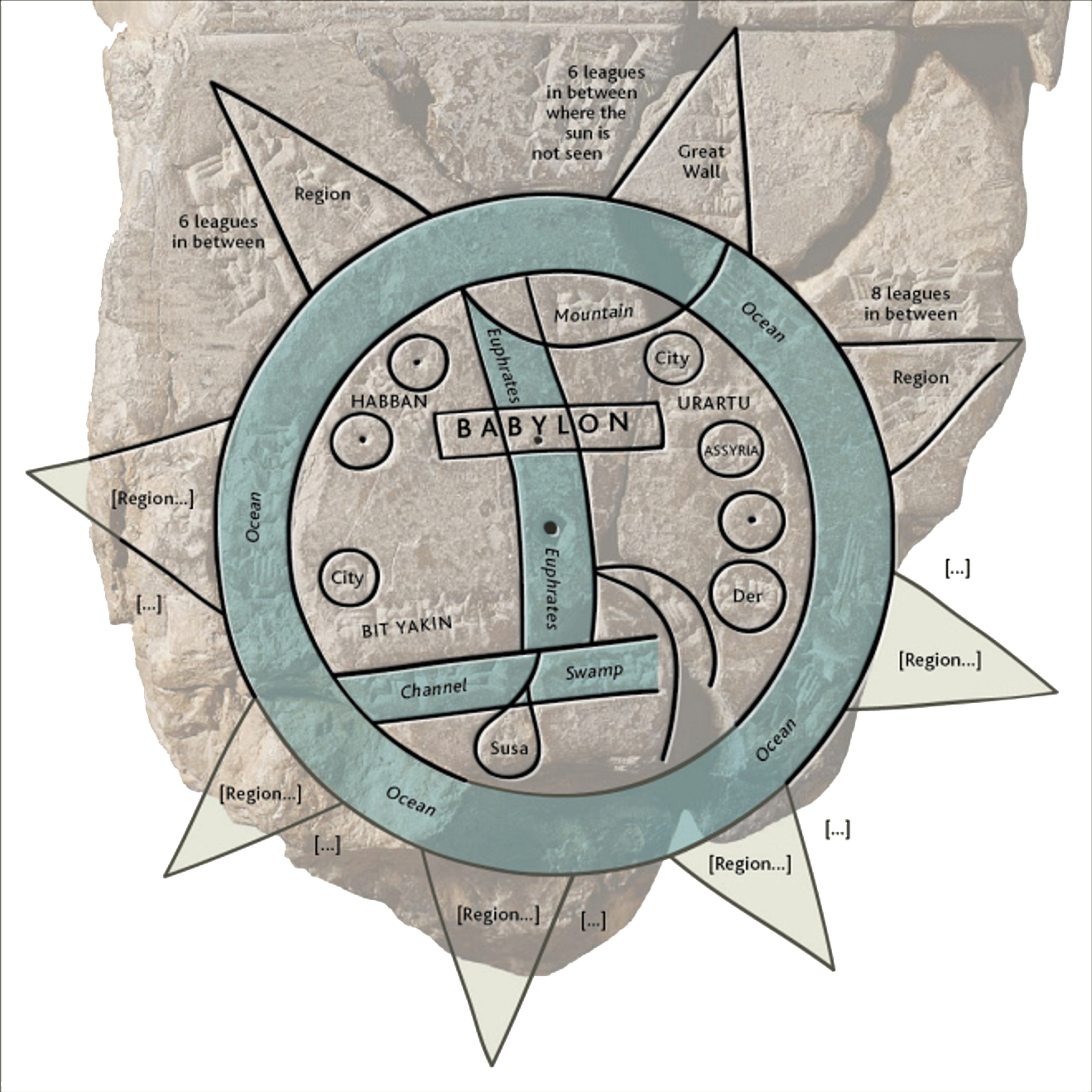
Image Caption: The cuneiform text of the reverse of the tablet describes features labeled on the map. Source: Diagram of Babylonian Map of the World (Travel Blog, May 19, 2012) [https://www.travelblog.org/photos/6933448]
The clay map of the world shows the world as a disc, surrounded by the ring of the 'Bitter River'; 'Babylon' is marked as a rectangle occupying both river banks; the Euphrates flows south to a horizontal band, whose right is marked 'marsh' or 'swamp' and left, 'outflow' or 'channel' — perhaps the Shatt al-Arab confluence that meets the 'Bitter River'; right of the 'marsh' is a double curving line with broken inscription; small circles mark city-states, including "Assyria" and "Der"; geographical areas are: Bit-Yakin (Aramaean territory); Habban (Kassite homeland, strangely placed west of Babylon); and Urartu (placed north of Assyria).
Beyond the "Bitter River" are eight regions (na-gu-u) at "6 (or 7) beru distant". The north-eastern "region" is "Where Shamash is not seen", where the sun rises, crosses the heavens, sets in the west, returning to the east through the underworld.
On the reverse of this tablet the eight nagu "regions" are described in eight broken paragraphs, marked "To the first (second, etc.) region to which you go (the distance is) seven beru". The map twice says six beru, whereas the reverse-side text, consistently says seven beru. A final paragraph summarises: "In all eight 'regions' of the four shores (kibrati) of the ea[rth …], their interior no one knows".
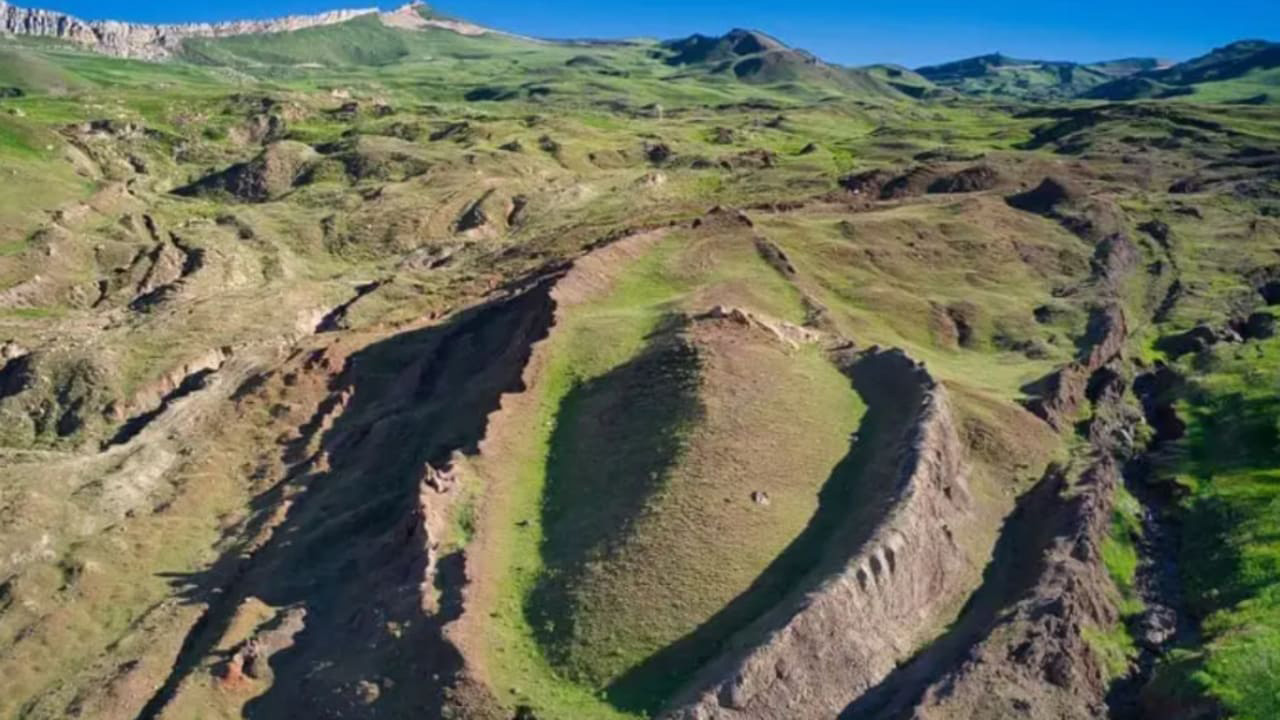 Image Caption: The Durupinar Formation (1,966 to 2,004 meters ASL) has marine deposits in nearby soil and a ship-shaped structure. Dimensions of the biblical ark (300 x 50 x 30 cubits = 510.5 x 85.1 x 51.1 feet, using Mesopotamian cubit of 20.42 inches) roughly match those of the Durupinar formation (538 x 86 x 19.6 feet, using a cubit of 20.64 inches for width or 21.52 inches for length — height is indeterminable with GPR). Allowing for erosion and deformation, they roughly match. Source: Fresh clues in Turkey spark renewed debate over Noah's Ark discovery (Jerusalem Post) [https://www.jpost.com/archaeology/archaeology-around-the-world/article-845277]
What is relevant to the Genesis flood story is the description on the Babylonian map's reverse side that describes how journeying to the mountain of "Urartu" (north of Assyria) would bring one to a formation as thick as a parsiktu-vessel. Since the word parsiktu is associated elsewhere in Babylonian texts only with the ark of Utnapishtim, the map seems to be indicating where Utnapishtim's ark came to rest. This is a point of agreement between the Genesis flood story's "Ararat," and the Babylonian account's "Urartu" as the location where the ark landed.
Image Caption: The Durupinar Formation (1,966 to 2,004 meters ASL) has marine deposits in nearby soil and a ship-shaped structure. Dimensions of the biblical ark (300 x 50 x 30 cubits = 510.5 x 85.1 x 51.1 feet, using Mesopotamian cubit of 20.42 inches) roughly match those of the Durupinar formation (538 x 86 x 19.6 feet, using a cubit of 20.64 inches for width or 21.52 inches for length — height is indeterminable with GPR). Allowing for erosion and deformation, they roughly match. Source: Fresh clues in Turkey spark renewed debate over Noah's Ark discovery (Jerusalem Post) [https://www.jpost.com/archaeology/archaeology-around-the-world/article-845277]
What is relevant to the Genesis flood story is the description on the Babylonian map's reverse side that describes how journeying to the mountain of "Urartu" (north of Assyria) would bring one to a formation as thick as a parsiktu-vessel. Since the word parsiktu is associated elsewhere in Babylonian texts only with the ark of Utnapishtim, the map seems to be indicating where Utnapishtim's ark came to rest. This is a point of agreement between the Genesis flood story's "Ararat," and the Babylonian account's "Urartu" as the location where the ark landed.
Locales of the Ark's Landing
Several sites have been proposed as the landing site of the famed ark of the flood. Yet there seems to be an implicit concensus among them as to the original locus of the ancient landing.
 Image Caption: Ark Landing Locales (blue sites): Mt Ararat summit, the Durupinar site, and the Kagizman Ridge are close (70 miles) — all are part of the same geological formation. Mt Nisir is 276 miles SSE of Ararat. Jebel Al-Cudi/Judi is 175 miles (282 kilometers) SSW of Ararat. All sites are within the borders of the Kingdom of Urartu (shaded red). Source: Middle East Map showing purported ark landing sites (Google Earth)
Mount Nimush (Nisir), mentioned in Gilgamesh Tablet XI, is part of the Zagros Mountain range. Many identify it with Pir Omar Gudrun (also Pira Magrun) (2,588 meters or 8,490 feet), near the city of Sulaymaniyah in Iraqi Kurdistan. Mount Nimush (Nisir) is located exactly 276 miles south of Mount Ararat.
Image Caption: Ark Landing Locales (blue sites): Mt Ararat summit, the Durupinar site, and the Kagizman Ridge are close (70 miles) — all are part of the same geological formation. Mt Nisir is 276 miles SSE of Ararat. Jebel Al-Cudi/Judi is 175 miles (282 kilometers) SSW of Ararat. All sites are within the borders of the Kingdom of Urartu (shaded red). Source: Middle East Map showing purported ark landing sites (Google Earth)
Mount Nimush (Nisir), mentioned in Gilgamesh Tablet XI, is part of the Zagros Mountain range. Many identify it with Pir Omar Gudrun (also Pira Magrun) (2,588 meters or 8,490 feet), near the city of Sulaymaniyah in Iraqi Kurdistan. Mount Nimush (Nisir) is located exactly 276 miles south of Mount Ararat.
Mount Ararat, the site of the Genesis flood story, is located in the Ağrı Province of Turkey near the Armenian and Iranian borders. It is a massive volcanic massif with two peaks: Greater Ararat (5,137 meters) and Little Ararat (3,896 meters). For centuries, searches targeted the highest peaks of Mount Ararat (Agri Dagi). Expeditions focused on the Ahora Gorge and the 'Ararat Anomaly' (irregular shapes seen in snow and ice).
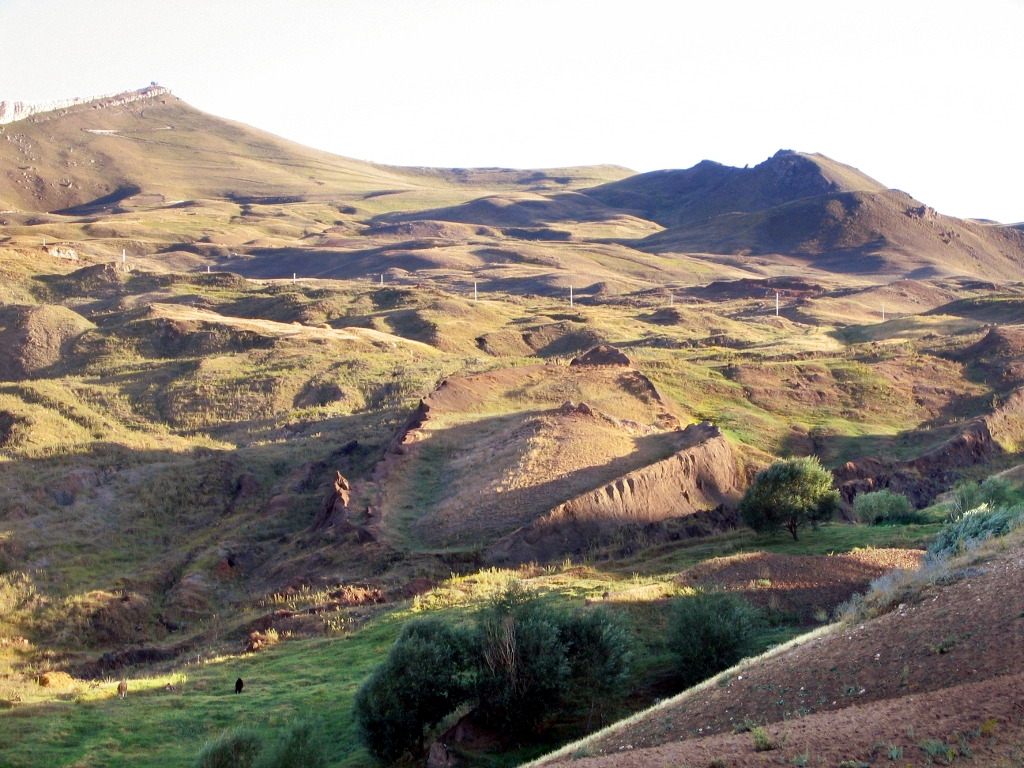 Image Caption: The Durupınar site is near several officially unnamed peaks, though Turkish locals call one of them Cudi Dağı, which some link to Arabic Al Cudi, the place the Quran names as the resting place of Noah's Ark. Source: Durupınar site (Wikipedia) [https://en.wikipedia.org/wiki/Durup%C4%B1nar_site]
The Durupınar site, located 18 miles south of Mount Ararat's peak near Doğubayazıt in Turkey, has a boat-shaped footprint in the earth. Geological testing and ground-penetrating radar have fueled theories that this is a preserved vessel, though many geologists consider it a 'syncline fold' that resulted from geological forces on a natural mudflow formation.
Image Caption: The Durupınar site is near several officially unnamed peaks, though Turkish locals call one of them Cudi Dağı, which some link to Arabic Al Cudi, the place the Quran names as the resting place of Noah's Ark. Source: Durupınar site (Wikipedia) [https://en.wikipedia.org/wiki/Durup%C4%B1nar_site]
The Durupınar site, located 18 miles south of Mount Ararat's peak near Doğubayazıt in Turkey, has a boat-shaped footprint in the earth. Geological testing and ground-penetrating radar have fueled theories that this is a preserved vessel, though many geologists consider it a 'syncline fold' that resulted from geological forces on a natural mudflow formation.
The Kagizman Ridge, located 70 miles west of Mount Ararat, is believed by some researchers to be where the Ark landed rather than on the main peak, since this ridge allegedly emerged during the receding phase of the Flood.
Jebel al-Cudi/Judi, mentioned in the Quran, is located at Cudi/Judi in Şırnak Province in southeastern Turkey. It is the landing site proposed by classical Arabic and early Syrian traditions.
When considering the southernmost sites proposed, Mount Nimush (Nisir) and Jebel al-Cudi/Judi, it is interesting to note that both sites lie on a trajectory pointing to Ararat from the perspective of the locales of their literary origins. Mount Nisir is on a trajectory pointing to Ararat from the perspective of ancient Sumerian cities (e.g., Ur and Uruk). Likewise, Jebel al-Cudi/Judi is on a trajectory pointing to Ararat from the perspective of later Syrian and Islamic centers (e.g., Medina or Mecca). Could these southernmost mountain references then have been to their authors merely waypoints of directional orientation? If so, then everything would seem to point to the Ararat range as the primary locale of the ark landing story.
Black Sea Deluge Hypothesis — The Event
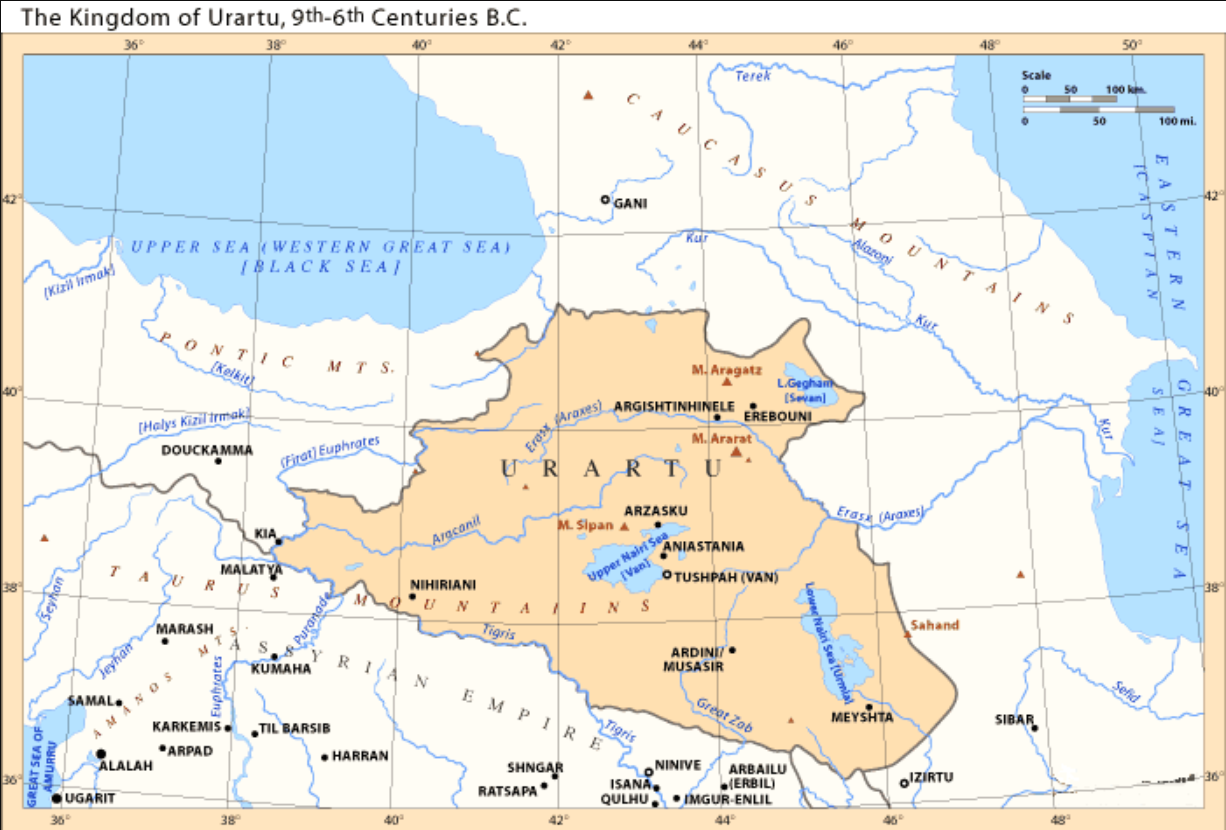 Image Caption: The Kingdom of Urartu (ca. 9th to 6th centuries BC). Source: Shahan Goenjian, The Ancient Kingdom of Urartu (ANCA) [https://anca.org/wp-content/uploads/2016/02/13-urartu-9-6mta-11.gif]
The fact that the biblical story of the flood emanates from the region of Urartu (Mount Ararat), whereas nowhere else do Hebrew ancestral traditions derive from that region, suggests that the Genesis story retains this locale as a vestigial trait of original local lore concerning a great regional flood.
Image Caption: The Kingdom of Urartu (ca. 9th to 6th centuries BC). Source: Shahan Goenjian, The Ancient Kingdom of Urartu (ANCA) [https://anca.org/wp-content/uploads/2016/02/13-urartu-9-6mta-11.gif]
The fact that the biblical story of the flood emanates from the region of Urartu (Mount Ararat), whereas nowhere else do Hebrew ancestral traditions derive from that region, suggests that the Genesis story retains this locale as a vestigial trait of original local lore concerning a great regional flood.
A widely known and debated theory is that of the Black Sea deluge hypothesis, which proposes that there was a catastrophic overflow from the Mediterranean Sea into the Black Sea via the Bosporus Strait around 5600 BC. The theory was proposed in 1997 by marine geologists William B.F. Ryan and Walter C. Pitman III of Columbia University.
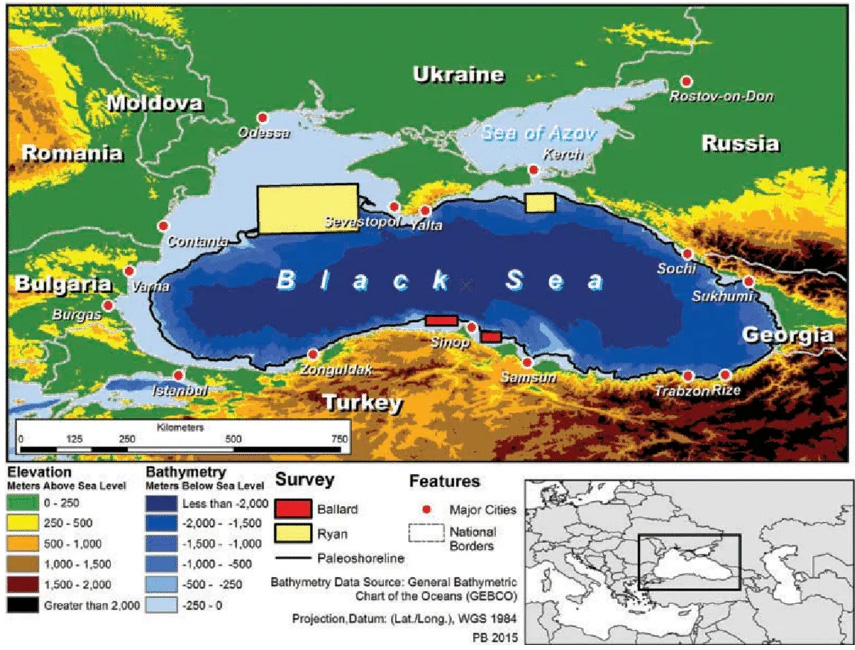 Image Caption: Map of Black Sea macro-region, showing approximate locations of deep-sea coring (Ryan) and underwater archaeological survey (Ballard). Source: Peter Bikoulis, Evaluating the impact of Black Sea flooding on the Neolithic of northern Turkey (Research Gate) [https://www.researchgate.net/figure/Map-of-Black-Sea-macro-region-showing-approximate-locations-of-deep-sea-coring-Ryan_fig4_282408969]
Deep-sea coring done in the waters of the Black Sea by William Ryan (1997) and architectural surveys done thereafter by Robert Ballard (1999) seem to authenticate the Black Sea flood event. Based on marine geology research concerned with the timing and rate of the Black Sea infilling, the Black Sea flood Hypothesis argues that the process was a catastrophic event ca. 7150 years ago that impacted the prehistoric peoples who lived along the ancient shoreline. It resulted in mass migrations of peoples to higher elevations on the surrounding shores above sea level.
Image Caption: Map of Black Sea macro-region, showing approximate locations of deep-sea coring (Ryan) and underwater archaeological survey (Ballard). Source: Peter Bikoulis, Evaluating the impact of Black Sea flooding on the Neolithic of northern Turkey (Research Gate) [https://www.researchgate.net/figure/Map-of-Black-Sea-macro-region-showing-approximate-locations-of-deep-sea-coring-Ryan_fig4_282408969]
Deep-sea coring done in the waters of the Black Sea by William Ryan (1997) and architectural surveys done thereafter by Robert Ballard (1999) seem to authenticate the Black Sea flood event. Based on marine geology research concerned with the timing and rate of the Black Sea infilling, the Black Sea flood Hypothesis argues that the process was a catastrophic event ca. 7150 years ago that impacted the prehistoric peoples who lived along the ancient shoreline. It resulted in mass migrations of peoples to higher elevations on the surrounding shores above sea level.
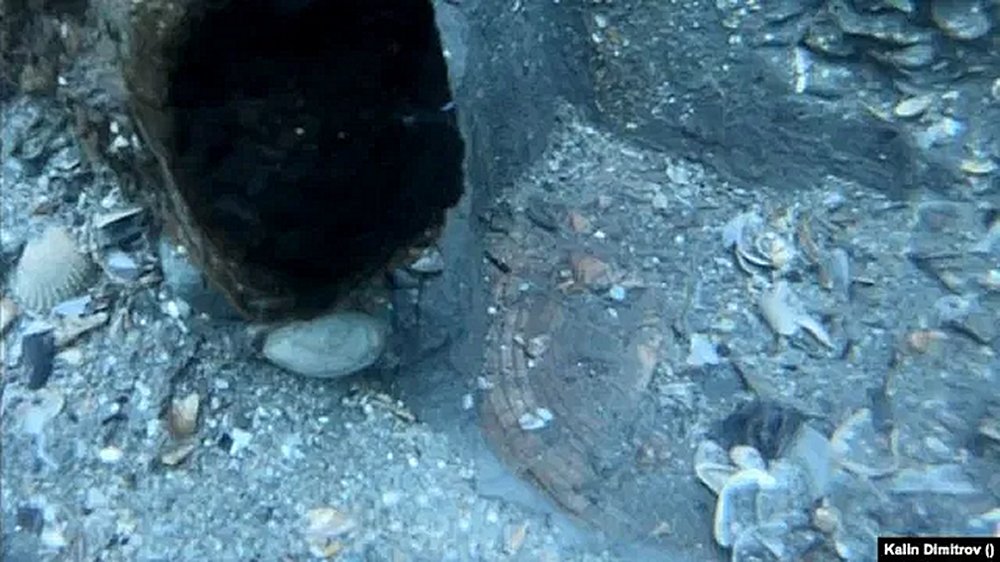 Image Caption: Submerged Chalcolithic settlement remains near mouth of Ropotamo River in Southeast Bulgaria. Source: 6,000-Year-Old Submerged Settlement Shows Black Sea Level Was Lower 5,000 Years Ago – ‘Black Sea Deluge’ Theory? (Ancient Pages) Photo: Kalin Dimitrov, Sozopol Center for Underwater Archaeology. [https://www.ancientpages.com/2020/11/30/6000-year-old-submerged-settlement-shows-black-sea-level-was-lower-5000-years-ago-black-sea-deluge-theory/]
Underwater archaeological findings in 2020 show submerged Chalcolithic building materials at a site near the Ropotamo River, in southeast Bulgaria. The site dates from 2,000 BC. Another interesting discovery is that 5,000 years ago, the level of the Black Sea was 5 meters lower than it is today.
Image Caption: Submerged Chalcolithic settlement remains near mouth of Ropotamo River in Southeast Bulgaria. Source: 6,000-Year-Old Submerged Settlement Shows Black Sea Level Was Lower 5,000 Years Ago – ‘Black Sea Deluge’ Theory? (Ancient Pages) Photo: Kalin Dimitrov, Sozopol Center for Underwater Archaeology. [https://www.ancientpages.com/2020/11/30/6000-year-old-submerged-settlement-shows-black-sea-level-was-lower-5000-years-ago-black-sea-deluge-theory/]
Underwater archaeological findings in 2020 show submerged Chalcolithic building materials at a site near the Ropotamo River, in southeast Bulgaria. The site dates from 2,000 BC. Another interesting discovery is that 5,000 years ago, the level of the Black Sea was 5 meters lower than it is today.
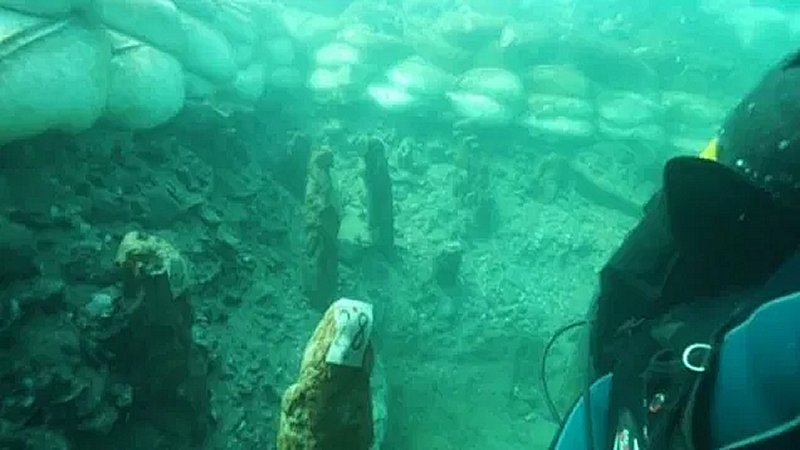 Image Caption: Submerged wooden stilts used to support homes in Bronze Age Bulgaria. Source: 6,000-Year-Old Submerged Settlement Shows Black Sea Level Was Lower 5,000 Years Ago – ‘Black Sea Deluge’ Theory? (Ancient Pages) Photo: Kalin Dimitrov, Sozopol Center for Underwater Archaeology. [https://www.ancientpages.com/2020/11/30/6000-year-old-submerged-settlement-shows-black-sea-level-was-lower-5000-years-ago-black-sea-deluge-theory/]
Archaeological remains discovered near the Ropotamo River, Bulgaria in 2020 reveal parts of wooden stilts people used to support their homes in the Bronze Age after a rise of the Black Sea surface level.
Image Caption: Submerged wooden stilts used to support homes in Bronze Age Bulgaria. Source: 6,000-Year-Old Submerged Settlement Shows Black Sea Level Was Lower 5,000 Years Ago – ‘Black Sea Deluge’ Theory? (Ancient Pages) Photo: Kalin Dimitrov, Sozopol Center for Underwater Archaeology. [https://www.ancientpages.com/2020/11/30/6000-year-old-submerged-settlement-shows-black-sea-level-was-lower-5000-years-ago-black-sea-deluge-theory/]
Archaeological remains discovered near the Ropotamo River, Bulgaria in 2020 reveal parts of wooden stilts people used to support their homes in the Bronze Age after a rise of the Black Sea surface level.
- Trigger Mechanism: Around 5600 BC, melting ice sheets worldwide raised global oceans until Mediterranean waters overtopped a natural land dam to form the Bosporus Strait.
- Flow Force: When the dam was breached at the Bosporus Strait, water allegedly cascaded into the Black Sea basin with the volume of 200 Niagara Falls, submerging some 100,000 square kilometers of land. Evidence of this is the deep gorge at Bosporus.
- Geomorphological Evidence: Submerged river beds along the shores of the Black Sea indicate that the surface of the sea was once 95 meters (300 feet) below its current sea level.
- Aquatic Life Transformation: Both Ryan (using carbon 14 dating) and Ballard (by observation) found a shift in shoreline shell types indicating a transition ca. 5600 BC from freshwater snails to marine mollusks at 450 feet below sea level.
- Archaeological Evidence: Human architecture was observed at a depth of 95 meters (300 feet) below the surface of the Black Sea along its ancient shoreline, suggesting that there was human occupation along the coast of a once fresh-water-surface lake in antiquity.
- Post-event Cultural Corroboration: Reference to Urartu/Ararat in the Babylonian and biblical flood stories and evidence of an advanced technological culture in the burial remains of the coastal settlements, as evidenced in the Varna Necropolis, suggest that there is a connection between these ancient flood myths and the localized watery destruction of that advanced human culture that once dwelt in the Black Sea basin.
Black Sea Deluge Hypothesis — Interpretative Implications
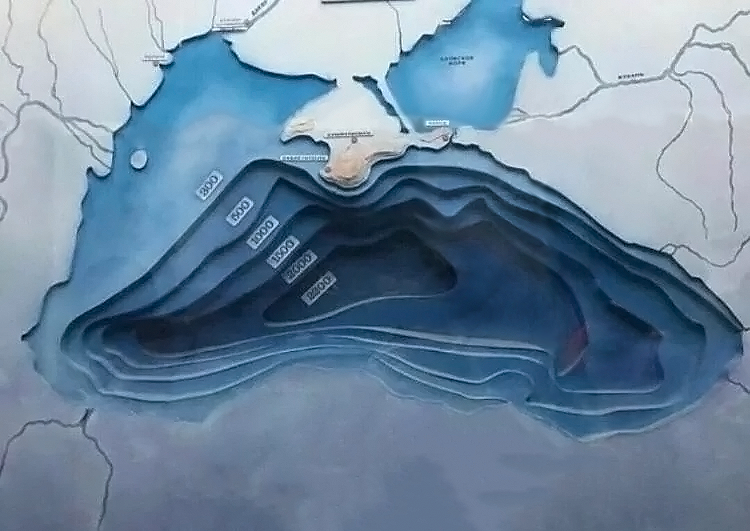 Image Caption: Black Sea floor elevations. Source: Black Sea (Reddit) [https://www.reddit.com/r/MapPorn/comments/p2ar1b/black_sea/]
The Black Sea deluge event has much data to suggest that about 5600 BC an ancient flood overcame the Neolithic culture that previously dwelt along the sea's ancient shores some 300 feet below sea level. That flood event seems historically plausible enough. How rapidly the flood came on, whether suddenly or gradually, is a matter for marine biologists to debate. But whether or not the Black Sea deluge event should be identified with the Genesis flood event is also a matter of concern and deliberation for biblical interpreters, since this identification would have implications for the question of one we should interpret the genre and language of the Genesis flood story.
Image Caption: Black Sea floor elevations. Source: Black Sea (Reddit) [https://www.reddit.com/r/MapPorn/comments/p2ar1b/black_sea/]
The Black Sea deluge event has much data to suggest that about 5600 BC an ancient flood overcame the Neolithic culture that previously dwelt along the sea's ancient shores some 300 feet below sea level. That flood event seems historically plausible enough. How rapidly the flood came on, whether suddenly or gradually, is a matter for marine biologists to debate. But whether or not the Black Sea deluge event should be identified with the Genesis flood event is also a matter of concern and deliberation for biblical interpreters, since this identification would have implications for the question of one we should interpret the genre and language of the Genesis flood story.
- How extensive was the flood: worldwide or regional? Bible interpreters should explore questions as to worldwide versus regional dimensions of: ancient versus modern mountain elevations, volumes of water needed to cover all mountains at highest flood depth, the source of water at onset and its location after abatement.
- How extensive was the human extinction event caused by the flood: universal or selective? Interpreters should question the continuity of worldwide versus regional cultures that predate and postdate the flood event.
- How extensive was the animal extinction event caused by the flood: universal or selective? Interpreters should analyze the worldwide versus regional land-based species to determine the feasibility of their migrations before and after the flood event.
- How long-lasting was the flood: years or a year? Interpreters should analyze the role of numbers applied to the Genesis flood onset, duration, and abatement to determine the relationship between story and history.
- When did the flood occur? Historians and Bible scholars should examine strategies for reconciling the dates of ancient flood stories with those of geomorphological traces of worldwide versus regional flood events.
Significance of the Flood Story
For Israel's Land Vision
We are first told that Noah is a righteous man (6:9); then, that God remembered Noah (8:1), then that Noah's offspring renewed the world (9:1, 7). The structure draws attention to the turning point in God's judgment — his grace toward Noah.
Overall, the concentric structure of the Flood Narrative (Genesis 6:9 to 9:29) complements its function. Its palistrophic structure mimics the swelling — high point — then repose of the waters. It begins with a threat of judgment and ends with the promise of continuous peace. So, the story ends well, but because it is a story of beginnings, in the denouement, not all ends as well as it should.
The account of Noah's curse on Ham's offspring, Canaan, in the closing tier (Genesis 9:22-27), would cast a vision before those Israelites returning from Egypt to the promised land to displace Canaan. Noah's curse on Canaan holds for Canaan's offspring a foreshortened future and provides a rationale for Israel's role in carrying out YHWH's removal of Caanaanite culture from Abraham's land.
For Israel's Messianic Division
Still, there is a warning implicit in the flood story that remains for future generations. Waters that provide a way of salvation may also destroy. The Bible thus depicts waters as a symbol of separation.
In 1 Peter 3:20-22, Peter draws a parallel between Noah's experience and baptism. Peter states that Noah and his family were 'saved through water,' which symbolizes baptism. Peter says the act of baptism into water is not merely a ritual cleansing but an appeal to God born of a good conscience, made possible through the death and resurrection of Jesus the Messiah.
Likewise, Israel in Moses' day, who passed through the sea, may have perceived the irony that the very waters that became their path of salvation were the means of God's destruction of Egypt's army.
In a similar way, Paul in 1 Corinthians 10:1-13 warned that, despite the fact that all Israel had been baptized into Moses in the cloud and in the sea, not all remained true to God. Most of that generation died in the wilderness. Paul thus warns against missing the significance of Moses' baptismal example.
Both Noah and Moses are figures of floodwater saviors. All who chose to follow these saviors during their lifetimes were delivered from the destruction God brought on those who refused. Even so, the apostles Peter and Paul aver that all will be saved who follow Messiah Jesus, who has made with the vessel of his own body a place of refuge and a way of escape from God's wrath.
For Israel's Role in World Redemption
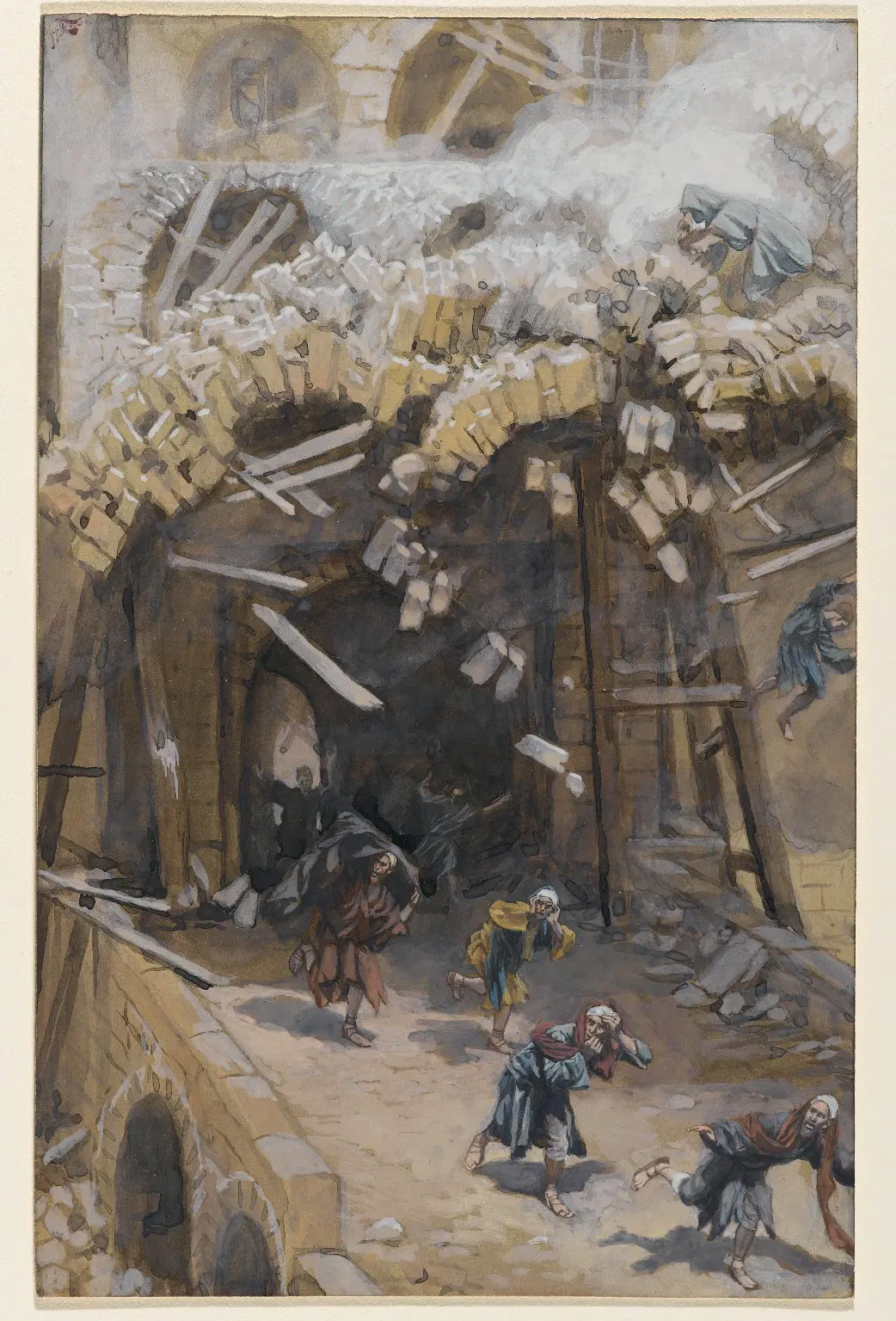 Image Caption: Jacques Tissot. The Tower of Siloam (Le tour de Siloë), 1886–1896. Opaque watercolor over graphite on gray wove paper. Source: Tower of Siloam (Brooklyn Museum) [https://www.brooklynmuseum.org/objects/4530]
The Tower of Siloam was a structure in Jerusalem that collapsed, killing 18 people. The incident is documented in the Gospel of Luke (13:1-9, especially vv. 4-5), where Jesus referenced the disaster while he was travelling toward Jerusalem. Jesus used the tragic current event to dispute the belief that victims of disasters likely die as a punishment for sins that are worse than those of their contemporaries. Jesus thus emphasized the need for all to repent.
Image Caption: Jacques Tissot. The Tower of Siloam (Le tour de Siloë), 1886–1896. Opaque watercolor over graphite on gray wove paper. Source: Tower of Siloam (Brooklyn Museum) [https://www.brooklynmuseum.org/objects/4530]
The Tower of Siloam was a structure in Jerusalem that collapsed, killing 18 people. The incident is documented in the Gospel of Luke (13:1-9, especially vv. 4-5), where Jesus referenced the disaster while he was travelling toward Jerusalem. Jesus used the tragic current event to dispute the belief that victims of disasters likely die as a punishment for sins that are worse than those of their contemporaries. Jesus thus emphasized the need for all to repent.
1Now there were some present at that time who told Jesus about the Galileans whose blood Pilate had mixed with their sacrifices. 2 Jesus answered, “Do you think that these Galileans were worse sinners than all the other Galileans because they suffered this way? 3 I tell you, no! But unless you repent, you too will all perish. 4 Or those eighteen who died when the tower in Siloam fell on them—do you think they were more guilty than all the others living in Jerusalem? 5 I tell you, no! But unless you repent, you too will all perish.”
6 Then he told this parable: “A man had a fig tree growing in his vineyard, and he went to look for fruit on it but did not find any. 7 So he said to the man who took care of the vineyard, ‘For three years now I’ve been coming to look for fruit on this fig tree and haven’t found any. Cut it down! Why should it use up the soil?’ 8 “‘Sir,’ the man replied, ‘leave it alone for one more year, and I’ll dig around it and fertilize it. 9 If it bears fruit next year, fine! If not, then cut it down.’”
The tower had likely been in a part of Jerusalem near the Pool of Siloam. Although no record outside the Bible describes its collapse, the sudden, accidental tragedy serves as a lesson for Jesus's contemporaries and a reminder that no one knows the day of their death, so all need to repent and be ready. Although Jesus was speaking to his contemporaries in Israel, as goes Israel, so go all peoples of the world. If Jesus' Jewish contemporaries needed to hear the warning about failing to hear his call for repentance, symbolized in the unfruitful fig tree, how much more should those outside Israel heed the warning of their example: forty years after Jerusalem's rejection of Jesus as God's Messiah, Jerusalem fell to the Romans and the great Diaspora began.
Like Jesus' warning to his contemporaries implicit in the analogy of the unfruitful fig tree (a figure of unrepentant Jews of his time — cf. Mark 11:12–21; Matthew 21:18–20), the story of Noah's flood, remains a warning to peoples of all nations. Now is the time to take refuge in that messianic vessel God commissioned as a shelter from judgment for sin. It is the consistent and central message of the Bible that all should repent before judgment comes suddenly on those who ignore God's warning and invitation to take refuge in his provision for escape from punishment for sins, the cross of Jesus, the Messiah sent for Israel's and the world's redemption.
The biblical story of redemption is filled with irony. One should not miss the irony of the flood account, that the reason for God's judgment on humanity — their culpable inclination to do evil (6:5) — should, after Noah's assuaging sacrifice, reveal God's inclination to show kindness on those who retain that very foible — their helpless inclination to do evil (8:21). In the same way, just as God could turn what Joseph's brothers intended for evil — their selling him into Egyptian slavery — into a great salvation, because God intended it for good, so in the same way God has been turning what Jesus' Jewish religious contemporaries intended for evil — their crucifixion of Jesus — into world redemption, because despite their intentions to rid themselves of him, by their actions they ironically performed their role as priests to offer up a sacrifice for sin that would bring about world redemption. That was always God's plan: to bless all the nations of the world through the seed of Abraham and so redeem the world.
Sources
- Anderson, Bernhard W. 1978. “From Analysis to Synthesis: The Interpretation of Genesis 1–11.” Journal of Biblical Literature 97, no. 1 (March): 23–39.
- Benner, Jeff A. Ugarit and the Bible (Ancient Hebrew Research Center) [https://www.ancient-hebrew.org/biblical-history/ugarit-and-the-bible.htm]
- Boyes, Philip J. The Social Context of Writing in Ancient Ugarit (The Ancient Near East Today, April 2022, Vol. 10.4) [https://anetoday.org/boyes-writing-ugarit/]
- Boyes, Philip J. Script and Society: The Social Context of Writing Practices in Late Bronze Age Ugarit. Oxford & Philadelphia: Oxbow, 2021. See pp. 133-135 on House of the Tablets, where the Ugarit Flood Tablet was found. [https://crewsproject.wordpress.com/wp-content/uploads/2021/03/boyes-2021-script-and-society-1.pdf]
- Büyükyıldırım, Oguz. 2400-year-old artifacts found in the Black Sea’s first scientific underwater excavation (Anatolian News, March 24, 2024) [https://www.anatolianarchaeology.net/2400-year-old-artifacts-found-in-the-black-seas-first-scientific-underwater-excavation/]
- Chisholm, Robert B. Jr. 2003. “History or Story? The Literary Dimension in Narrative Texts.” In Giving the Sense: Understanding and Using Old Testament Historical Texts, Edited by David M. Howard Jr. and Michael A. Grisanti, 54–73. Grand Rapids, Michigan: Kregel Publications.
- Clines, D.J.A. 1994 Theme in Genesis 1-11. Pp. 285-309 in I Studied Inscriptions from before the Flood, ed. R.S. Hess and D.T. Tsumura. Winona Lake IN: Eisenbrauns.
- Cubit (Wikipedia) [https://en.wikipedia.org/wiki/Cubit]
- Cultural diffusion (Sakura) [http://www.navymule9.sakura.ne.jp/Cultural_diffusion.html]
- Cylinder seal with "priest-king" and altar on the back of a bull. (Morgan Library & Museum) [https://www.themorgan.org/exhibitions/online/she-who-wrote/priest-king]
- Hammerly-Dupuy, Daniel. Some Observations on the Assyro-Babylonian and Sumerian Flood Stories (Scribd) [https://www.scribd.com/document/460505895/Some-Observations-on-the-Assyro-Babylonian-and-Sumerian-flood-stories-Daniel-Hammerly-Dupuy]
- Eames, Christopher. "The Imago Mundi: Babylonian Directions to Noah’s Ark" (Armstrong Institute of Biblical Archaeology, November 11, 2024) [https://armstronginstitute.org/1127-the-imago-mundi-babylonian-directions-to-noahs-ark]
- The Great Flood: Atrahasis (Livius.org) [https://www.livius.org/articles/misc/great-flood/flood3_t-arahasis/]
- Early Alphabetic Writing Found at Lachish (BAS) [https://www.biblicalarchaeology.org/daily/biblical-artifacts/inscriptions/early-alphabetic-writing-found-at-lachish/]
- Emerton, J.A. 1987 An Examination of Some Attempts to Defend the Unity of the Flood Narrative in Genesis: Part I. Vetus Testamentum 37: 401-20.
- Emerton, J.A. 1988 An Examination of Some Attempts to Defend the Unity of the Flood Narrative in Genesis: Part II. Vetus Testamentum 38: 1-21.
- Gilibert, Alessandra. Urban Squares in Late Bronze Age Ugarit: a Street View on Ancient Near Eastern Governance. Journal of Near Eastern Studies. October 2021. Vol. 80, No. 2. [https://www.journals.uchicago.edu/doi/10.1086/716076]
- Heidel, A. 1949 The Gilgamesh Epic and Old Testament Parallels (2nd ed.). Chicago: University of Chicago Press.
- Johns, Warren H. A New Flood Chronology Based on Seven-Day Creation Cycles Answers Research Journal 15 (April 13, 2022): 61–82 [https://answersresearchjournal.org/noahs-flood/flood-chronology-seven-day-cycles/]
- Kikawada, Isaac M., and Arthur Quinn. 1985. Before Abraham Was: The Unity of Genesis 1–11. Nashville, Tennessee: Abingdon Press.
- Longacre, R.E. 1976 The Discourse Structure of the Flood Narrative. Pp. 235-62 in Society of Biblical Literature 1976: Seminar Papers, ed. G. MacRae. Missoula: Scholars.
- Millard, A.R. 1994 A New Babylonian ‘Genesis’ Story. Pp. 114-28 in I Studied Inscriptions from before the Flood, ed. R.S. Hess and D.T. Tsumura. Winona Lake IN: Eisenbrauns.
- Moorey, P.R.S. What Do We Know About the People Buried in the Royal Cemetery? Expedition Magazine 20, no. 1 (October 7, 1977) [https://www.penn.museum/sites/expedition/what-do-we-know-about-the-people-buried-in-the-royal-cemetery/] ["… based originally on textual evidence from Mesopotamia and more recently on calibrated Carbon-14 dating as well, the levels in which the royal tombs lay are now dated approximately to the century from 2600 to 2500 B.C. It is a period known in archaeology as Early Dynastic IIIA (sometimes the ‘Fara period’) when for the first time contemporary written records begin to throw real light on the structure and culture, even some of the personalities, of Sumerian society."]
- Oden, R.A. 1981 Divine Aspirations in Atrahasis and in Genesis 1-11. Zeitschrift für die Alttestamentliche Wissenschaft 93.
- Peshev, Nikolay. 7 500 B.C. The Flood In The Black Sea. Studies legends and disputes (Medium, March 16, 2017) [https://medium.com/@nikolaypeshev/7-500-b-c-the-flood-in-the-black-sea-studies-legends-and-disputes-891ac73a2081]
- Royal Cemetery at Ur (Wikipedia) [https://en.wikipedia.org/wiki/Royal_Cemetery_at_Ur]
- Saade, Gabriel. Ougarit et son royaume. Des origines à sa destruction. Institut Français du Proche Orient, Bibliothèque Archéologique et Historique, Tome 193. IFPO, Beyrouth, 2011. First edition. In-4, 550 pages. [https://www.persee.fr/doc/bah_0768-2506_2011_mon_193_1]
- Shea, William H. 1979. “The Structure of the Genesis Flood Narrative and Its Implications.” Origins 6, no. 1 (January 1): 8–29.
- Speiser, E.A. 1969 Creation Myths and Epics. Pp. 60-99 in Ancient Near Eastern Texts Relating to the Old Testament, ed. J.B. Pritchard. Princeton: Princeton University Press.
- Submerged Civilizations of the Black Sea: Archaeology, Climate, and Myth (GuideBG) [https://www.guidebg.com/submerged-civilizations-of-the-black-sea/#h-geological-shifts-and-the-black-sea-flood-hypothesis]
- Tigay, J.H. 1982 The Evolution of the Gilgamesh Epic. Philadelphia: University of Pennsylvania Press.
- Tsumura, David T. Genesis and Ancient Near Eastern Stories of Creation and Flood: Part IV (Associates for Biblical Research, Bible Archaeology, March 7, 2007) [https://biblearchaeology.org/research-articles/genesis-and-ancient-near-eastern-stories-of-creation-and-flood-part-iv/]
- Tsumura, D.T. 1988 ‘The Deluge’ (mabbûl) in Psalm 29:10. Ugarit-Forschungen 20: 351-55.
- Turner, Laurence A. 1993. “The Rainbow as the Sign of the Covenant in Genesis IX 11–13.” Vetus Testamentum 43, no. 1 (January): 119–124.
- Wenham, G.J. 1994 The Coherence of the Flood Narrative. Pp. 436-47 in I Studied Inscriptions from before the Flood, ed. R.S. Hess and D.T. Tsumura. Winona Lake IN: Eisenbrauns.
- Wenham, Gordon J. 1978. “The Coherence of the Flood Narrative.” Vetus Testamentum 28, no. 3 (July): 336–348.
- Wenham, Gordon J. 2015. Rethinking Genesis 1–11: Gateway to the Bible. Eugene, Oregon: Wipf and Stock Publishers.
- Wiener, Noah. The Animals Went in Two by Two, According to Babylonian Ark Tablet (Biblical Archaeology Society, January 2014) [https://www.biblicalarchaeology.org/daily/news/the-animals-went-in-two-by-two-according-to-babylonian-ark-tablet/]